
Top Quick Highlights
For anyone who wants the short version before making a call, here's what to keep in mind:
Private caregivers usually cost less per hour, but you take on the employer responsibilities: taxes, insurance, background checks, and backup coverage.
Agencies cost more, but that price includes screening, training, liability coverage, and a replacement caregiver if yours is unavailable.
If your parent's needs are light and predictable, and a family member can actively manage the arrangement, private care can work well.
If your parent's needs are complex, unpredictable, or involve long stretches alone with a caregiver, an agency is usually the safer choice.
Always ask who handles backup coverage before committing to either option. This is where families get caught off guard most often.
Get everything in writing, whether it's a private arrangement or an agency contract, so expectations are clear from day one.
It's okay to switch if your first choice isn't working. This is a common experience, not a failure.
The bigger question isn't just "private or agency." It's whether the arrangement is sustainable and able to grow with your parent's needs over time.
At some point, most families researching care for an aging parent land on the same fork in the road. Do you hire a private caregiver directly, someone you find through a referral, a classified ad, or word of mouth, or do you go through a home care agency that handles the hiring, training, and scheduling for you?
It's a bigger decision than it looks like on the surface. The right answer isn't the same for every family, and it isn't really about which option is "better." It's about what your parent needs, what you can realistically manage, and how much risk you're comfortable carrying yourself. This guide walks through the real differences, so you can make the choice that actually fits your situation instead of guessing.
Private Caregiver vs. Home Care Agency : What's the Actual Difference?
A private caregiver is someone you hire on your own, without an agency in between. You find them, you interview them, you set the pay rate, and you're typically responsible for things like payroll taxes, background checks, and finding backup coverage if they're sick or on vacation.
A home care agency, on the other hand, employs and manages caregivers for you. The agency handles recruiting, background checks, training, scheduling, payroll, and liability insurance. You're paying for the caregiver's time, but you're also paying for the infrastructure and accountability behind that person. Both paths fall under the broader umbrella of in-home care, which simply means your parent stays in their own home rather than moving to a facility.
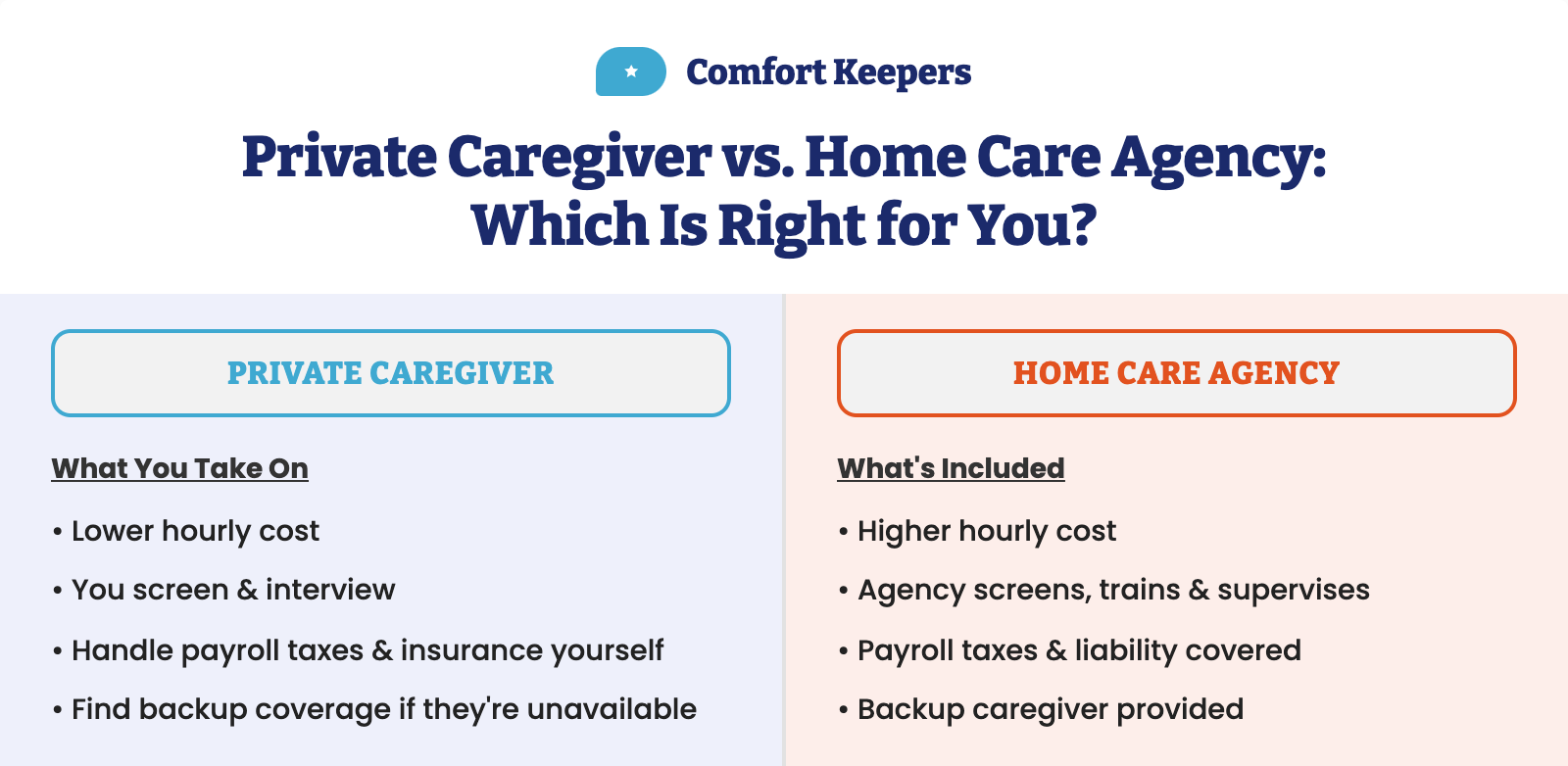
Neither approach is inherently right or wrong. They just shift responsibility to different places, and that shift matters more than most families expect until something goes wrong.
Cost: The First Thing Most Families Ask About
Private caregivers are almost always less expensive per hour than agency caregivers, sometimes significantly so, since you're not paying for the agency's overhead, insurance, training programs, or administrative staff. This is usually the single biggest reason families consider going private.
But the full cost comparison isn't quite that simple. When you hire privately, you typically become the caregiver's employer, which means payroll taxes, workers' compensation considerations, and potentially unemployment insurance depending on your state. If the caregiver gets injured in your home and you haven't handled workers' comp properly, you could be personally liable. If they call out sick with no backup plan, you're the one scrambling to cover the gap, sometimes by taking time off work yourself.
Agency care costs more per hour, but that price includes a layer of protection and convenience that's easy to underestimate until you need it: a replacement caregiver shows up if yours is sick, the agency carries liability insurance, and you're not the one handling tax paperwork or unemployment claims.
It's worth being specific about what "employer responsibilities" actually means if you hire privately. In most cases, if you're paying a caregiver directly and controlling how, when, and where they work, the IRS considers you a household employer, not just someone paying a contractor. That typically means withholding and paying Social Security and Medicare taxes, potentially paying federal and state unemployment tax, and issuing a W-2 at year's end rather than a 1099. Some families hire a payroll service to handle this, which adds a bit of cost back into the private option that's easy to miss when you're only comparing hourly rates on paper. This complete guide to hiring an in-home caregiver in Philadelphia walks through these cost and logistics questions in more detail if you want to dig deeper before deciding.
A Side-by-Side Look
Private Caregiver | Home Care Agency | |
Hourly cost | Generally lower | Generally higher |
Who screens the caregiver | You | The agency |
Backup if caregiver is sick | Usually your responsibility | Agency typically provides coverage |
Payroll taxes and insurance | Usually your responsibility | Handled by the agency |
Training and supervision | Not provided | Ongoing, agency-managed |
Consistency of care | Depends on one person | Agency can adjust staffing as needs change |
Liability if something goes wrong | Largely falls on you | Covered by agency insurance |
The Hidden Risks of Going It Alone
This is the part that doesn't come up enough in casual conversation, but it matters. When you hire a caregiver privately, you're taking on the role of employer, whether or not that feels official. That comes with real responsibilities:
Background checks fall entirely on you. Agencies run criminal background checks, verify references, and often check driving records as part of their standard process. If you're hiring privately, you have to do this yourself, and it's easy to skip a step when you're stretched thin or trust a personal referral a little too much.
There's no backup plan built in. If your private caregiver gets sick, has a family emergency, or simply doesn't show up one day, there's no one else to call. Agencies are built to handle exactly this kind of gap.
You're likely the legal employer. Depending on how you structure the arrangement, you may be responsible for payroll taxes, workers' compensation, and unemployment insurance. Getting this wrong isn't just a paperwork headache, it can create real legal and financial exposure.
Training and oversight are on you too. Agencies typically provide ongoing training, supervision, and a way to address performance issues. With a private hire, if something isn't working, you're the one who has to notice it, address it, and potentially start the search over.
There's less accountability if something goes wrong. If a private caregiver mishandles a situation, mismanages medication, or something is stolen, your recourse is limited. Agencies carry insurance and bonding specifically to cover these situations.
None of this means private caregivers are unsafe or unreliable. Plenty of families have wonderful experiences this way, often through trusted referrals. It just means the responsibility for catching problems shifts almost entirely to you, and that's worth being honest with yourself about before you commit.
When a Private Caregiver Might Make Sense
A private caregiver tends to work well for families in a few specific situations. If your parent needs relatively light, predictable support, like a few hours of company and light housekeeping a few days a week, the lower complexity of a private arrangement can be manageable. It also tends to work better when a family member is available to actively manage the relationship, handle backup coverage, and stay on top of the administrative side. And it can make sense financially for families on a tighter budget who understand the tradeoffs and are willing to take on the added responsibility themselves. If this sounds like your situation, this guide on how to hire a private caregiver in Philadelphia walks through what to look for and how to protect yourself along the way.
When an Agency Is Usually the Safer Choice
An agency tends to be the better fit when your parent's needs are more complex or unpredictable, when consistency and backup coverage really matter, or when no one in the family has the bandwidth to manage hiring, scheduling, and payroll on top of everything else already on their plate. It's also usually the better choice if your parent is going to be alone with the caregiver for extended periods, since the added screening, training, and supervision reduce risk in a way that's hard to replicate on your own. And if peace of mind matters more to you than shaving a few dollars off the hourly rate, an agency generally delivers that more reliably.
If you're trying to figure out where your own family falls on this spectrum, it can help to first get honest about how much care your parents actually need. This guide on 10 signs your elderly parent needs help is a useful starting point if you're still figuring out whether it's time for outside support at all.
Questions to Ask Before You Decide
Whichever direction you're leaning, a few questions can help you avoid surprises later.
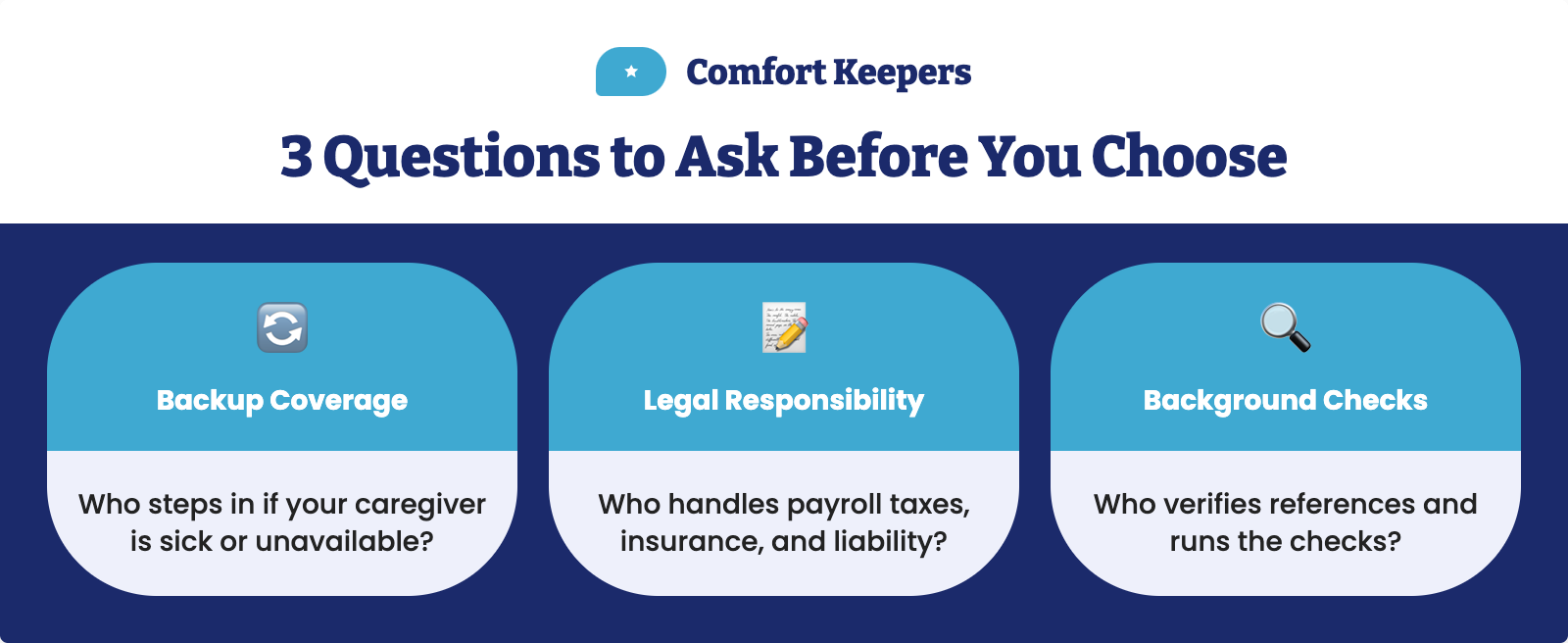
How is a replacement handled if the caregiver is sick or unavailable?
Who is legally responsible for payroll taxes, workers' compensation, and liability?
What background checks and reference verification actually happen, and who conducts them?
How are concerns or performance issues addressed if something isn't working?
What happens if your parent's needs increase over time? Can care scale up smoothly?
Is there a written agreement outlining hours, responsibilities, and cost?
If you decide an agency is the better fit, it's worth going in prepared. This list of questions to ask when interviewing a home care agency in Philadelphia covers the specifics in more depth.
What If You're Already Using One and It's Not Working?
It's fairly common for families to start with one approach and realize partway through that it isn't the right fit, whether that's a private caregiver who isn't reliable enough, or an agency that isn't providing the consistency they'd hoped for. That doesn't mean you're stuck. If you're in this position, this guide on how to switch home care providers in Philadelphia can help you make the transition without disrupting your parent's routine more than necessary.
Private Caregiver vs. Agency: What Actually Matters Most
It's worth stepping back for a moment, because the private-versus-agency decision, while important, is really just one piece of a bigger picture. What tends to matter most in the long run is whether your parents feel comfortable and genuinely cared for, whether the arrangement is sustainable for your family without burning everyone out, and whether there's a plan in place for when needs change, because they usually do.
If you're still early in this process and trying to understand what home care actually looks like day to day, this in-home care guide for Philadelphia families covers the basics in more detail. And if you're also weighing whether in-home care makes sense at all compared to a move to assisted living, this comparison of home care versus assisted living in Philadelphia might help you zoom out and think through the bigger decision first.
The Emotional Side of Choosing Between a Private Caregiver and an Agency
It's easy to talk through the logistics of cost, insurance, and backup coverage and forget that this decision carries real emotional weight too. Choosing between a private caregiver and an agency often feels like choosing how much trust to hand over, and to whom. Some families feel more at ease with one familiar person their parents have grown attached to. Others feel safer knowing there's a whole team, and a company, standing behind the care their parents receive.
Neither instinct is wrong. If you're leaning one way but still feel uneasy, that feeling is worth paying attention to. It often means there's a question you haven't fully answered yet, like what happens on the days things don't go smoothly, or who you'd call if you were suddenly unreachable for a week. Working through those scenarios in advance, even if they feel unlikely, tends to settle a lot of the uncertainty that makes this decision feel so heavy in the first place.
How to Decide Between a Private Caregiver and a Home Care Agency
If you're still torn, try answering these questions honestly. Your answers will usually point you in the right direction:
Can I personally handle payroll taxes, background checks, and finding backup coverage if needed? If not, an agency likely makes more sense.
Does my parents need consistent, predictable support, or are their needs more complex and prone to change? More complexity generally favors an agency.
Do I have the time and attention to actively manage a private hire, including addressing problems directly? If your plate is already full, an agency takes that burden off your hands.
Is there a strong, trusted personal referral for a private caregiver, or would I be starting from scratch? A cold hire without a trusted reference carries more risk than a warm one.
How much does peace of mind matter to me relative to the hourly rate? If the answer is "a lot," that's usually a sign toward an agency.
There's no scoring system here, just a way to get honest with yourself before you commit either your parent's safety or your own bandwidth to an arrangement that might not fit.
Comfort Keepers: A Trusted Home Care Agency in Philadelphia
If you're leaning toward an agency after weighing all of this, Comfort Keepers serves families throughout Philadelphia and the surrounding suburbs, with caregivers who are screened, trained, and matched to your parent's personality and needs, not just their schedule. Every caregiver goes through background checks and ongoing training, and if your regular caregiver is ever unavailable, there's a team behind them to make sure care doesn't just stop.
You can learn more about the caregivers behind the care, see the range of personal care services available beyond companionship, or check the full list of areas served to see if your parent's neighborhood is covered. If you'd rather just talk it through, the contact page is the easiest way to start that conversation, with no pressure to commit on the spot.
Frequently Asked Questions
Is a private caregiver cheaper than a home care agency?
Usually, yes, on an hourly basis. Private caregivers typically charge less per hour since there's no agency overhead built into the rate. But once you factor in payroll taxes, workers' compensation, background checks, and the cost of covering gaps when your caregiver is unavailable, the total cost gap often narrows more than families expect.
Do I need to pay taxes if I hire a private caregiver?
In most cases, yes. If you're paying a caregiver directly and controlling how, when, and where they work, the IRS generally considers you a household employer, which typically means withholding Social Security and Medicare taxes, potentially paying unemployment tax, and issuing a W-2 rather than a 1099. A tax professional or household payroll service can help you handle this correctly.
Can I switch from a private caregiver to a home care agency later?
Yes, and it's a common transition. Families often start with a private caregiver and move to an agency once needs become more complex or the administrative burden becomes too much to manage alone. This guide on how to switch home care providers in Philadelphia walks through how to make that change smoothly.
Are home care agencies insured if something goes wrong?
Generally, yes. Reputable agencies carry liability insurance and bonding to cover situations like theft, injury, or caregiver misconduct. With a private hire, this kind of protection usually doesn't exist unless you've specifically arranged for it yourself.
What happens if my private caregiver quits or gets sick with no notice?
You're typically responsible for finding coverage yourself, since there's no backup system built into a private arrangement. This is one of the most common reasons families eventually move to an agency, where a replacement caregiver is usually available.
The Bottom Line
There's no universally right answer here, only the answer that's right for your family's specific situation. Some families do wonderfully with a private caregiver they trust completely. Others need the structure, backup, and accountability that only an agency can reliably provide. The goal isn't to pick the cheapest option or the most convenient one. It's to pick the one that lets you sleep at night knowing your parents are genuinely looked after, and that you have real support if something doesn't go as planned.
Take your time with this decision. Ask the hard questions upfront, whichever direction you lean, and remember that getting it right matters far more than getting it fast.