

A man in Woodbridge called me on a Friday afternoon last fall. The hospital had just told him his wife was coming home Monday, and the discharge nurse had said someone should be with her overnight. He could not do it himself. He used a wheelchair, and he could not get up to help her in the dark. He was not panicking on the phone. He was just stuck, the way a lot of people are stuck on that first call, holding a discharge date and a list of things they suddenly have to handle. We started looking for overnight coverage that same afternoon.
That moment is the one almost every family runs into. A nurse appears in the doorway and says your father is being discharged tomorrow, and a recovery you thought was the hospital's job is suddenly yours. He goes home with a walker he has used for three days, a fistful of new prescriptions, a physical therapy schedule, and a page of warning signs from the surgeon. The hospital did its part well. The hard part starts the day he walks back through his own front door.
This is the busy surgery season at JFK University Medical Center in Edison and Robert Wood Johnson University Hospital in New Brunswick. Knees, hips, hearts. The first two weeks home are when an older adult is most likely to fall or to end up back in the hospital. A trained caregiver through those weeks helps with bathing safely, getting to the bathroom at night, meals, medication reminders, and rides to physical therapy. The help can be a few hours a day, overnights, around the clock, or live-in. We will give you a cost over the phone once we hear the situation.
The Edison medical cluster, and why it matters
The Edison to New Brunswick corridor is one of the densest medical clusters in central New Jersey. JFK University Medical Center in Edison handles a large share of the area's elective surgery. Robert Wood Johnson University Hospital in New Brunswick is the regional academic center for cardiac, neuro, and complex cases. The JFK Johnson Rehabilitation Institute and JFK Hartwyck provide the inpatient rehab step between hospital and home for a lot of seniors. Saint Peter's University Hospital rounds out the cluster.
Discharge planning at each of these sends some seniors straight home, some through rehab first, and some to a nursing facility. The right path depends on the procedure, how your loved one was doing before the admission, and what kind of help is waiting at home. The smoothest discharges happen when the home is ready and a caregiver is lined up before the discharge date, not scrambled for after.
What the first two weeks home really look like
The discharge paperwork covers the basics. Weight-bearing limits. The PT schedule. The new prescriptions. Surgical-site care. The signs that mean call the surgeon. What the paperwork does not say is how your father gets from the bedroom to the bathroom at 2 a.m. on a walker he has used for three days. It does not say what he eats on a morning he does not feel like eating. It does not say who is in the house when his daughter drives back to her job in New Brunswick on day four.
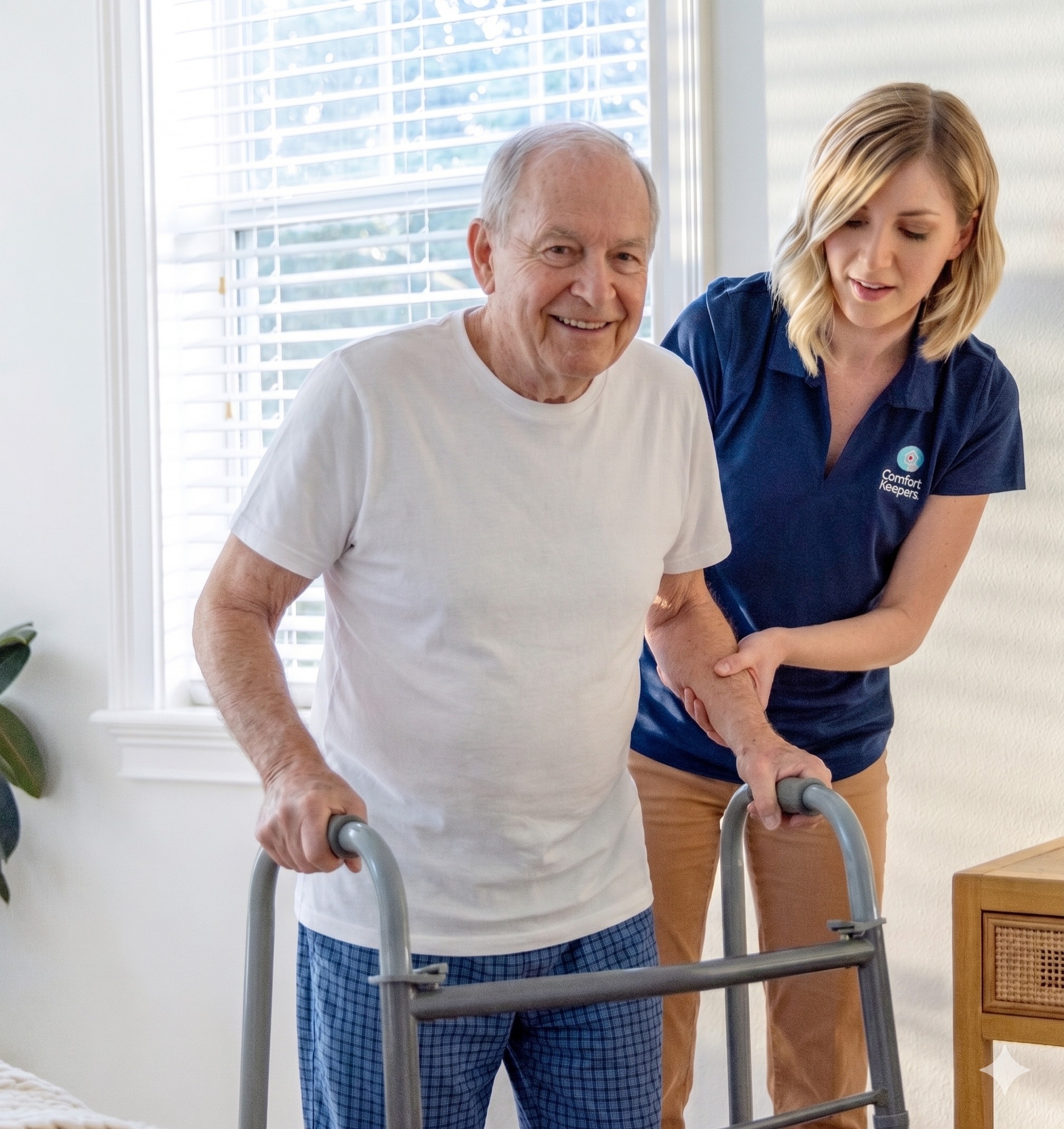
A trained caregiver answers those questions. Ours help with the daily routines: getting dressed and bathed around the surgical site, breakfast and lunch, light housework, getting safely to the kitchen and the bathroom. They do not give prescriptions, but they set out the morning pills and remind your loved one to take them. They watch for the warning signs the surgeon mentioned. They get your loved one to outpatient PT and back.
The Agency for Healthcare Research and Quality's Re-Engineered Discharge toolkit points to the days right after discharge as the highest-risk stretch for a return to the hospital. A trained caregiver in the home through that window is one of the simplest ways to avoid the second trip.
Choosing how much help you need
How much care a family needs comes down to who is home and what the nights look like. Sometimes a caregiver for four to six hours in the morning is plenty, covering the hardest part of the day while a spouse or adult child handles the rest. A daughter in Highland Park called us as her mother was finishing rehab, wanting exactly that: daytime help with safe movement, bathing, meals, and the therapy exercises, with the family taking the evenings. We set it up as a weekday morning schedule and built in room to scale back as her mother got steadier.
For other families, the night is the worry. That was the case with the husband I mentioned, whose wife was coming home that Monday. The danger was a fall in the dark, and there was no one in the house who could help her up. Overnight coverage fit that, someone awake in the home from evening through morning, so he could sleep.
After a complicated surgery, or for a senior who lives alone, or when the family is far away, the answer is fuller coverage. One wife in Iselin turned down an early discharge she did not believe was safe and waited until her husband could come straight home with a live-in caregiver already in place. She told us she planned to be right next to him for the first month, and she wanted the breathing room a live-in gives. With live-in care, one caregiver lives in the home for stretches at a time and gets the sleep and breaks New Jersey law requires. When a senior is up much of the night or has to be watched every minute, around-the-clock care covers the day with shifts instead, and we keep that number of caregivers as small as we can so your loved one keeps seeing familiar faces.
Our knowledgeable Director of Nursing, Brittany Minervini, RN, makes the recommendation as part of the written Plan of Care after the in-home Assessment. The Plan is reviewed at 30 and 60 days. After a surgical recovery, most families reduce the hours as the senior gets stronger. That is the right outcome. One daughter told me on the first call that she figured this would be temporary, that her mother mainly needed to get her strength back. I told her the best result we can get is that her mother gets fully steady again and does not need anybody. We mean that when we say it.
How a family in Edison gets started
Your dedicated Client Care Coordinator handles the day-to-day. For families here, that is often our organized Client Care Coordinator, Roxanne Sturm. She is the person you call when the PT appointment moves or the caregiver match needs a change. She works closely with Brittany on the clinical side and with the caregivers in the field. If you ever feel something is off, you call Roxanne, and telling her is not telling on the caregiver. It is helping us do the job you are paying us for.
We have worked with the discharge teams at JFK Edison, RWJUH, and the JFK rehabs on Middlesex County cases for many years. They know our caregivers, and they know what a hand-off to a home in Metuchen or Colonia looks like when we run it. We can often start within a few days of the discharge, and faster when the case is urgent and a caregiver is available. It does take a little lead time, though. Getting the right caregiver is not like ordering a pizza off a shelf, so the first call is the moment to start the clock.
What this costs
Cost varies with the level of care and the schedule. A few hours a day is the least expensive starting point. Overnights sit in the middle. Live-in runs well under around-the-clock coverage, because the overnight is paid as sleep hours. Full awake coverage is the highest.
After we talk it through, we will give you a cost over the phone. Long-term care insurance covers home care for many Middlesex County families. We file the paperwork and take an assignment of benefits, so the insurance company pays us directly. Veterans and surviving spouses may qualify for VA Aid and Attendance benefits; the va.gov Aid and Attendance page walks through eligibility. Medicare does not pay for non-medical home care. WinnJam has been doing this work in Central Jersey since 2001.
Frequently Asked Questions
How soon should we start home care after a discharge?
The first three days home are when most families realize they need help. If the discharge planner at JFK Edison or RWJUH flagged any concern, lining up care before the discharge is even better. We can sometimes start within a few days of the first call when the case is urgent, but a little lead time always helps.
Can we get someone for nights only?
Yes. Overnight care is one of the most common ways families start after a discharge, especially when a spouse is home in the daytime but a fall in the dark is the real fear. A caregiver stays from evening through morning so the rest of the household can sleep.
My father came home from JFK Edison confused. Is that normal?
It is common, and it often has a name: hospital delirium. The hospital disrupts sleep, stacks new medications, and runs people a little dehydrated. Most of the time it clears over days to weeks at home, with familiar routines, good hydration, and someone watching for the warning signs. If it does not clear, tell the doctor.
Does Medicare cover this?
Medicare does not pay for non-medical home care. Long-term care insurance often does, and we bill the carrier directly when the policy allows. VA Aid and Attendance helps eligible veterans and surviving spouses.
How long do most families need care after surgery?
The heaviest help is the first two weeks. Many families step the hours down after that. The 60-day Plan of Care review is the natural moment to scale back as your loved one gets stronger.
Let's have a conversation
If your loved one is coming home to Edison, Metuchen, Iselin, Colonia, Woodbridge, New Brunswick, or anywhere in Middlesex or Union County after a hospital stay, call us at (732) 710-4289. The consultation is no-cost, and there is no obligation. My staff and I have these conversations every day. We will listen, give you a straight answer about the level of care that fits, and walk you through the next steps. Our work is to elevate the human spirit, one home and one family at a time.