

It is the third week of June, the sun is still bright over the backyard at half past seven in the evening, and the parent with dementia who was settled all morning has turned anxious and restless right around the dinner hour. I have sat with a lot of Gloucester County families who tell me the same thing about this stretch of the year. The days get long and beautiful, the grandkids are out of school, and the person you are caring for gets harder to manage right when everyone hoped the opposite would happen. That late-afternoon stretch goes sideways. If that is happening in your house, you did not do anything wrong, and you are not the only family on your street going through it.
What sundowning actually is
Sundowning is not a diagnosis a doctor writes down. It is a pattern. There is a stretch of hours, usually late afternoon into evening, when a person with Alzheimer's or another dementia is more confused, more anxious, or more restless than they were that morning.
The Alzheimer's Association explains the behavior on its caregiving pages. Nobody knows the exact cause. The likely pieces are a disrupted internal clock, plain tiredness after a long day of mental effort, fading light that a dementia brain finds harder to read, and the day's stress piling up. The National Institute on Aging covers the same ground in its tips for coping with sundowning. The themes line up: routine, predictability, light earlier in the day, and less going on in the late afternoon.
Why June makes it harder in a Washington Township home
Two things change in June. First, the days get long. Around the longest day of the year, in late June, Gloucester County gets close to fifteen hours of daylight, sunrise in the early morning and sunset well past dinnertime. For most of us that is a gift. For a brain that already struggles to read light cues, the long bright evening can scramble the day.
Second, the heat climbs. Here is the part families miss. Dehydration is a common sundowning trigger, and it does not show up as thirst. Older adults often do not feel thirsty even when their body needs fluids. Mild dehydration can look like confusion. By late afternoon, a little dehydration plus a long day of mental effort plus the still-bright evening can stack into one hard hour. The CDC's guidance on older adults and heat notes that the seniors most at risk are also the ones least likely to feel thirst until they are already behind.
What our caregivers do in Sewell and Mullica Hill homes
Our compassionate caregivers, working with our knowledgeable Director of Nursing, Lynn Guice, RN, who has spent more than 30 years in nursing, try a small set of changes with each family. Not every one of these works for every person. We try the ones that fit.
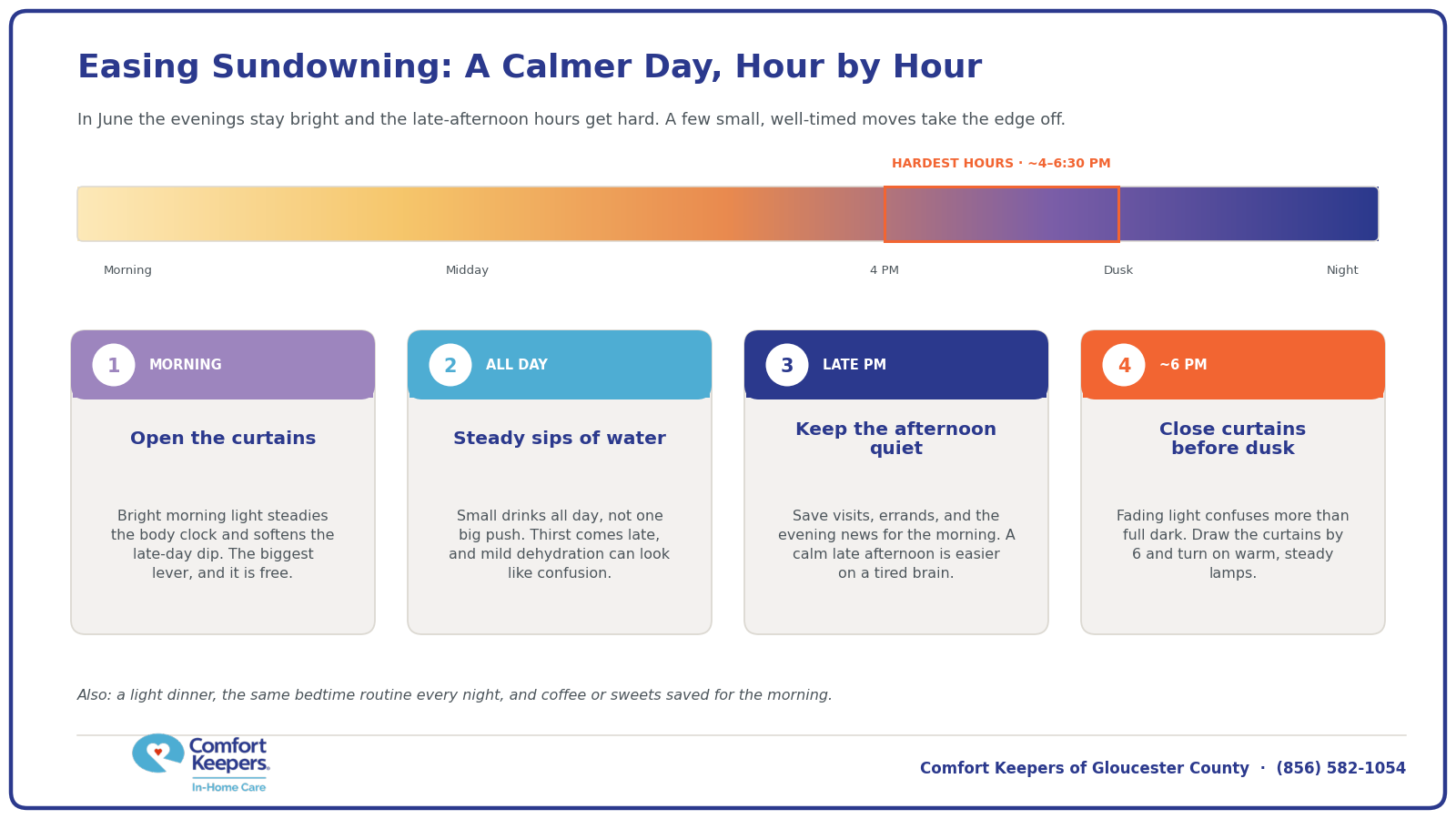
Anchor the morning with bright light. Open the curtains. Get your loved one to the breakfast table near a window. Morning sun strengthens the body clock and softens the late-afternoon dip. This is the biggest lever we have, and it costs nothing.
Hold the afternoon as a quiet hour. Visitors, phone calls, errands, and the evening news are all easier on a dementia brain in the morning. The late afternoon is the wrong time for the granddaughter's visit, even though that is when it feels natural to schedule it.
Hydrate in a steady drip, not a big push. A small drink with breakfast, mid-morning, lunch, mid-afternoon, and dinner keeps the mild dehydration that triggers late-day confusion from setting in.
Close the curtains before the light starts to fade. This one surprises people. The fading light at dusk is often harder on a dementia brain than full dark with the lamps on. Closing the curtains around 6 p.m. and turning on warm, steady lamp light cuts the visual confusion of a long sunset.
A light dinner and the same bedtime routine, in the same order every night, help too. Save the coffee and the sweets for the morning, since both can stir up agitation later in the day.
We worked with a family in the Washington Township area last summer whose father was fine until about four o'clock, then turned anxious and wanted to "go home" while sitting in his own living room. We moved his daughter's visits to mid-morning, got the curtains closed before dusk, and kept water in front of him all day. It did not cure anything. But the four o'clock hour stopped being the worst part of their day, and that was the whole point.
When to call us
If you are caring for a parent or spouse with dementia in Pitman, Sewell, Washington Township, Glassboro, Mullica Hill, Woodbury, or anywhere in Gloucester County, and the late afternoons are getting harder, call us. The consultation is no-cost. We will listen, ask about the daily routine, and help you figure out whether a few hours of companion care, a standing afternoon visit, or respite care so you can rest fits the situation. Respite simply means we step in so the family caregiver gets a real break.
When dementia is part of the picture, our experienced Director of Nursing, Lynn Guice, RN, leads the in-home Assessment and builds the written Plan of Care with you. Your dedicated Client Care Coordinator, one of our caring office leads like Tabitha Nathu, handles scheduling and the day-to-day questions, so you always reach someone who already knows your family. Our caregivers are trained in our Alzheimer's Association-recognized Positive Pathways™ approach to memory care.
Frequently Asked Questions
What is sundowning?
Sundowning is the late-day confusion, restlessness, or agitation that affects many people with dementia. It usually starts in the late afternoon and runs into the evening. June's long days shift the body's internal clock and often make it worse. Families in Washington Township, Sewell, Glassboro, and Mullica Hill can take some of the edge off with steady routines, bright light early in the day, a calm late afternoon, and a few small changes at sunset. Our trained caregivers do this work every day, and we are glad to walk you through it.
My mother gets agitated every afternoon around 4. Is that sundowning?
It often is, especially when the pattern is steady and the mornings are calmer. The hour matters less than the pattern. Some families see the shift at three, some at five. The picture is the same.
Will medication help?
Sometimes. The first move is almost always the routine and environment changes above. Medications for sundowning have mixed evidence and real side effects in older adults, so most dementia specialists ask families to try the behavioral approach for several weeks first. We work with the family doctor when medication is on the table.
Can a caregiver come just for the afternoon and evening?
Yes. A late-afternoon and evening shift is a common setup when a loved one is fine in the morning and harder later. Some families add overnight coverage on top of that. Others move to live-in care when the family caregiver is worn down.
Does Medicare pay for this?
This is the question we hear most, so let me answer it plainly. Medicare does not pay for non-medical home care. Long-term care insurance often does, and we file that paperwork for you and bill the carrier directly. One thing worth checking: if your loved one has a dementia diagnosis and Original Medicare Parts A and B (not a Medicare Advantage plan), they may qualify for up to 72 hours a year of in-home care at no cost through Medicare's GUIDE program. Our Pitman office is a GUIDE partner through PocketRN. Call us and we will check on the first call.
Is your office NIHCA-accredited?
Yes. Our Pitman office is NIHCA-accredited, uses the Interactive Caregiving™ model, and our caregivers are trained in the Positive Pathways™ approach to memory care.
Talk to us
If the late afternoons are getting hard with a parent or spouse who has dementia, give us a call at (856) 582-1054. You will reach our office, not a call center. Tell us what is happening at four o'clock, and we will help you figure out the next small step. The first conversation costs you nothing. Our work is to elevate the human spirit, one home and one family at a time.







