

Out here the driving is the thing. Mullica Hill still feels like farm country, the old village on Main Street, the stands along the county roads, houses set back on a little land. It is a good place to grow older, right up until the day the driving gets hard. When a parent in Harrison Township can no longer get themselves to the doctor in Sewell or the pharmacy in Woodbury, the isolation can arrive before any obvious health crisis does. That is often the first real sign a family out here notices.
Most families we talk to are not looking for a lot. They want their parent to stay in the house they love, and they want a little help so the distance and the quiet do not turn into something worse. The research on that second part is sobering. When older adults give up driving, it is not just a lost convenience. A systematic review in the Journal of the American Geriatrics Society found that driving cessation nearly doubled the risk of depression and was tied to faster declines in physical, social, and thinking skills. Isolation carries its own medical cost. The National Academies of Sciences reported that being socially isolated is linked to about a 50 percent higher risk of dementia, and a 2024 study of rural older adults aging in place found isolation running well above the roughly one-in-four rate seen in the general 65-and-older population. Out on the back roads of Harrison Township, where the next house can be a field away, those numbers are not abstract. In-home care is one of the ways families here keep the quiet from turning into decline.
You do not have to start big
The best time to bring someone in is before you think you need to, and with fewer hours than you would guess. A caregiver twice a week, a couple of hours, is plenty to start. Your father gets used to the company while the need is still light. The caregiver learns the house, the medications, the dog, the long driveway. Then when something changes, and it usually does, there is already a trusted person in place instead of a stranger arriving during a hard week.
We would rather right-size the help than oversell it. A senior sitting in the house with a caregiver who has run out of things to do gets discouraged fast. Start small and add hours as the need grows.
What the help looks like
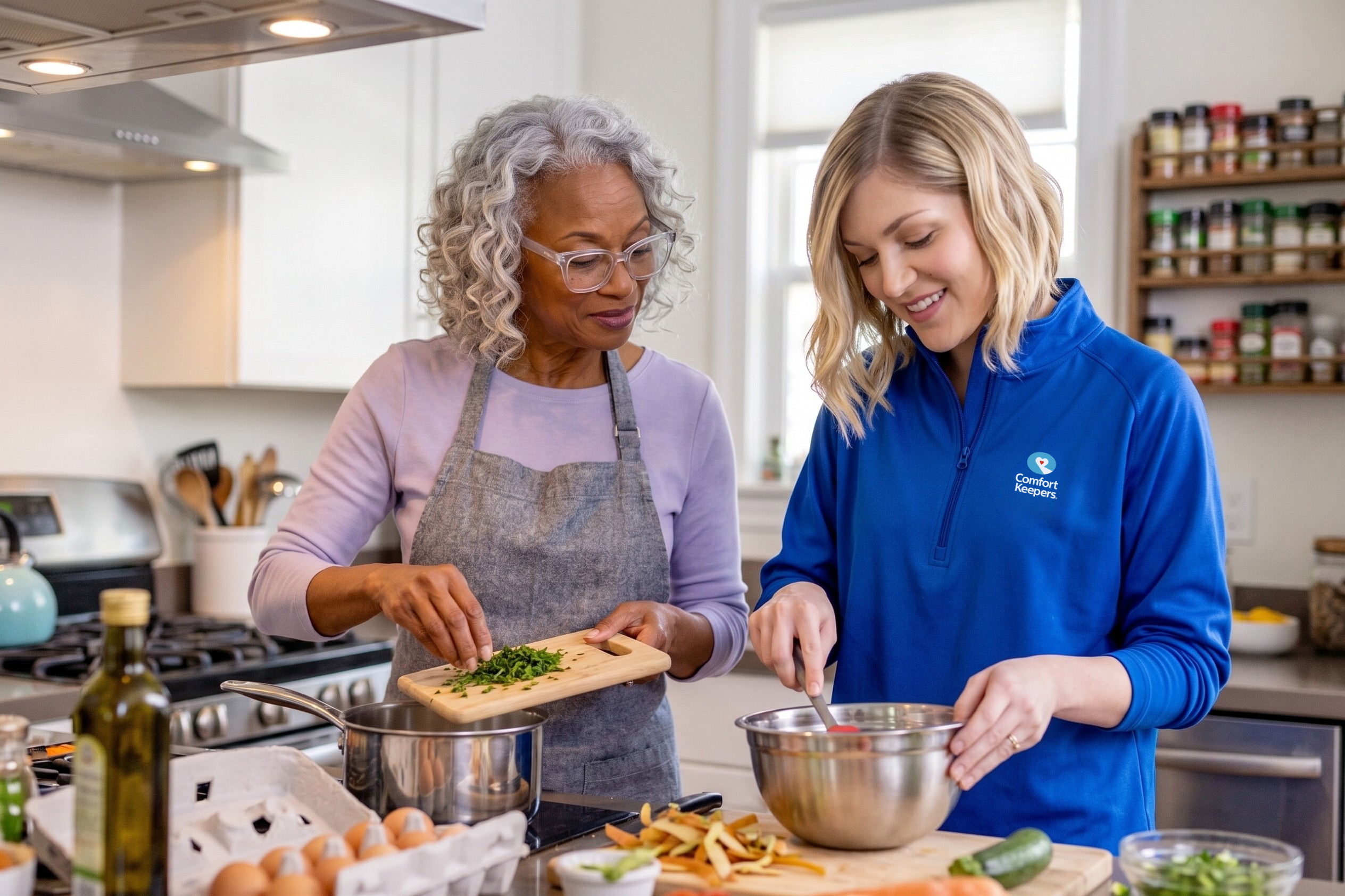
At the lighter end is companion care: real meals, the light housekeeping, laundry, rides to appointments, and steady company. For an older adult alone on a back road who has stopped driving, those rides and that company are often the whole point. One of our caregivers realized her client, a widower, had quietly stopped keeping his own appointments because he had no way to get to them and would not ask his kids. She got him back on schedule, and his family had no idea how far things had drifted until she flagged it.
When there is hands-on help involved, bathing, dressing, getting around safely, that is personal care, done by a certified home health aide. Every one of our caregivers in New Jersey is a CHHA, which is 72 hours of training before they ever step into a home, plus our own program. And for families who need more, live-in care puts one caregiver in the home for stretches at a time, the same person week after week. Most families do not know live-in is even an option; it is worth asking about before you assume you need round-the-clock shifts.
The team behind the caregiver, and who we send
A family out here does not just get an aide. Our experienced Director of Nursing visits before care starts, walks the home with you, makes it safe for your parent and the caregiver, and writes the plan for the days. Your Client Care Coordinator, Charice Creecy, who goes by CC, is your one call for anything, a schedule change, a question, a need in the house, and she is the one who matches the caregiver to your parent on skill, personality, and, out here especially, where the caregiver lives, because a caregiver who knows these roads and can reliably reach a Mullica Hill farmhouse is worth a great deal.
Which brings up the question every family asks: who is this person. Amanda Soto does our Pitman hiring, and she does not stop at a background check. She calls each caregiver's references herself and weighs their real work history and years in the field, because the check tells you what is on a record and the reference calls tell you who someone actually is. Many of our caregivers have been with us for years. After hiring, we keep notes on every caregiver across every home and watch for patterns, so a concern that shows up in more than one home ends that caregiver's time with us, and you are never the one left to prove something felt off.
What we can and cannot promise
Care takes a little lead time, and it can take a touch more out here where geography matters to the match. A good fit usually takes a few days, not a few hours, and we will tell you when a caregiver can start rather than promise a time we cannot keep. That said, we have filled cases the very next day, so if you are in an emergency, tell us and we will do everything we can to accommodate you. We also do not take every case. If a home is not safe for a caregiver, we will say so plainly, and sometimes point you toward a better answer.
If you are watching a parent in Mullica Hill, Harrison Township, or nearby in Glassboro or Clayton get more isolated as the driving gets harder, that is the right time to call, before it becomes a crisis. We have these conversations all day, and there is no obligation to use us. Call us at (856) 582-1054.