

Dementia, or Just Getting Older? How to Tell the Difference
"I don't know if this is dementia or just normal aging." We hear that on the phone all the time, often from a son or daughter who is a little embarrassed to be calling. By the time families say it, they are usually already carrying the load: watching Mom repeat herself, covering for Dad when he gets confused, quietly fixing the little mistakes before anyone else notices.
Some forgetfulness really is part of getting older. But dementia is not just aging, and waiting too long to tell the difference is what turns a manageable situation into a crisis.
About 1 in 9 Americans age 65 and older is living with Alzheimer's, the most common cause of dementia, according to the Alzheimer's Association. So a lot of families are quietly carrying this same question. Let us walk through what is normal, what is not, the in-between stage most people have never heard of, and when it is time to call the doctor and maybe get a little help at home.
What normal age-related forgetfulness looks like
As we get older, the brain changes. It can take a little longer to pull up a name or a word, especially when you are tired or stressed. You might misplace your keys or glasses and then find them after retracing your steps. You forget a neighbor's name at a party and remember it an hour later. You miss a bill or a medication dose once in a while during a hectic week. You ask the same question twice because you were distracted the first time.
Doctors sometimes call this age-associated memory impairment. Here is the key point: it is annoying, but it does not change how the person runs their life. They are still managing the household, paying the bills, driving familiar routes, and keeping themselves safe, maybe with a few more lists and a little more time. If that is what you are seeing, mention it at the next checkup, but it is not by itself a sign that your parent is losing their mind.
What dementia looks like in real life
Dementia is different. It is not one disease. It is the umbrella word for a group of conditions, like Alzheimer's, that damage brain cells over time and affect memory, reasoning, judgment, language, and even personality enough that daily life is no longer safe or independent. Here is the pattern families usually describe:
Memory loss that changes the day, not just the moment. It is not "where are my keys." It is "we had that conversation?" said three times in one evening, with no memory of it later.
Trouble with familiar tasks. They have paid the bills for forty years, and suddenly the checkbook is a mess, or the oven gets left on, or a simple recipe turns into confusion.
Getting lost in time or place. They lose track of the date or the season, or they get turned around driving to the grocery store they have used for decades.
Losing the thread. You notice them dropping out mid-sentence, repeating the same story back to back, or reaching for odd words so conversation gets hard to follow.
Changes in judgment and safety. They give money to a stranger on the phone, dress for winter on a hot day, or insist on driving when it clearly is not safe.
Mood and personality shifts. A gentle parent turns suspicious or fearful. A social person starts to withdraw, or seems flat, anxious, or irritable in a way that does not fit who they have always been.
If you find yourself quietly covering for a parent all day, redoing tasks, double-checking the stove, sorting out the finances, watching so they do not wander, you are not being dramatic for wondering about dementia. You are paying attention.
Dementia is not all one thing
It also helps to know that dementia comes in different forms, and the type shapes what you see. Alzheimer's disease is the most common, and it usually moves as a slow, steady decline in memory. Vascular dementia often arrives in steps, a clear drop after a small stroke, then a plateau. Lewy body dementia can bring alertness that swings through the day, visual hallucinations, and movement changes that look a little like Parkinson's. Frontotemporal dementia tends to show up first as changes in personality, judgment, or language rather than memory, which is why it gets missed early. A doctor sorts out which one it is. Knowing they differ helps explain why two people with dementia can look so different, and why the care plan has to fit the person, not a label.
The in-between: mild cognitive impairment
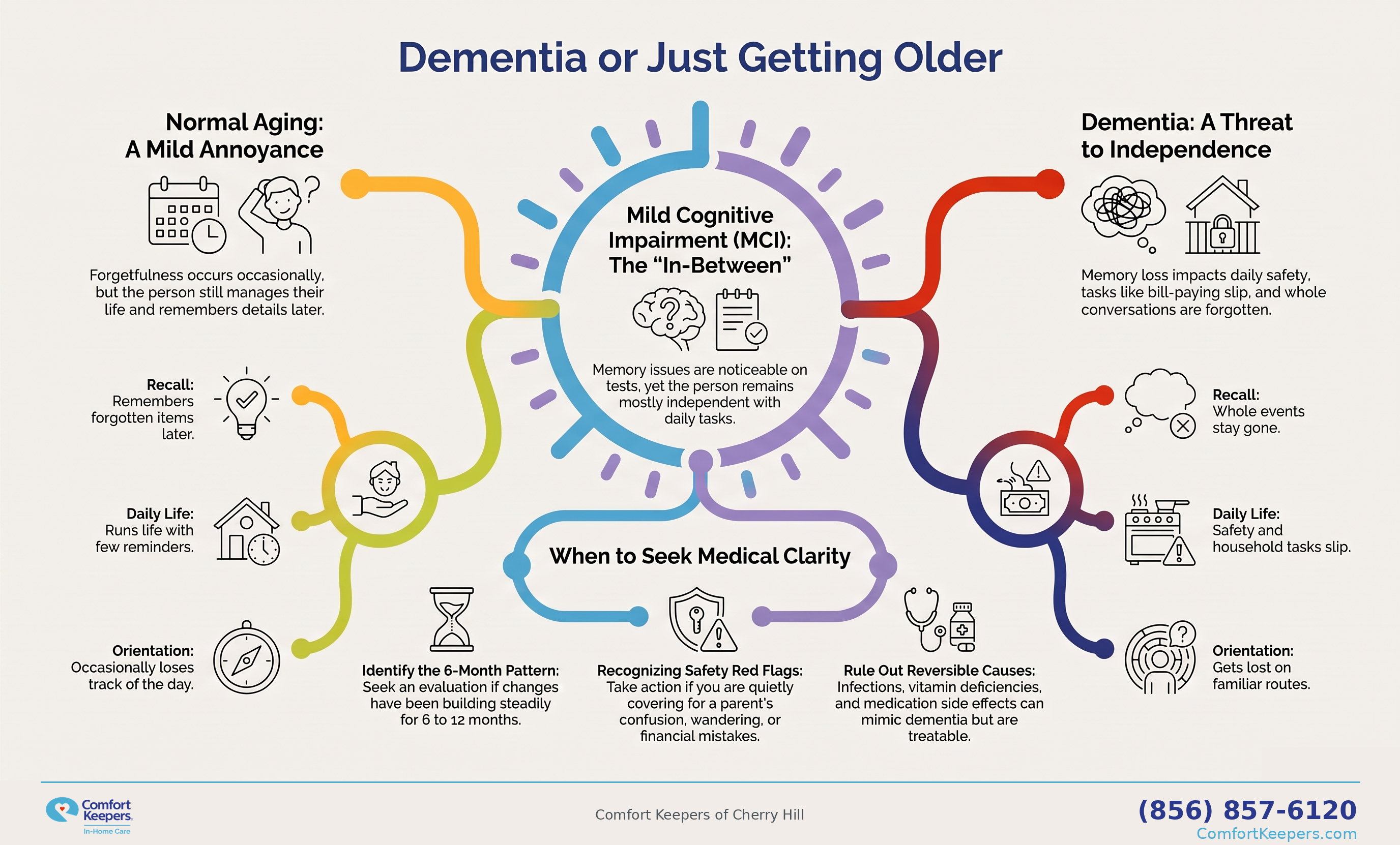
There is also a middle space between normal aging and dementia, and most families have never heard of it. Doctors call it mild cognitive impairment, or MCI. It is when someone is more forgetful than you would expect for their age, but they are still mostly managing their own life.
With MCI, the memory or thinking problems show up on testing, but the person is still independent with everyday tasks, what clinicians call the activities of daily living, though they may need more time, more lists, or help with the complex ones like finances. Some people with MCI stay stable for years, and some even improve, especially when other issues like sleep, depression, or medication side effects are treated. Others go on to develop dementia over the next several years, which is why doctors usually suggest a check-in every 6 to 12 months. If your gut says "something is off, but they are not falling apart," MCI is often the label that fits that feeling, and it is exactly the stage where planning ahead makes the biggest difference.
A simple way to compare them
| Normal aging | Possible dementia | |
|---|---|---|
| Do they remember later? | Usually. The name, the plan, or the missing item comes back to them. | Often no. Whole conversations or events are gone and stay gone. |
| Daily life | A mild annoyance, but they still run their life with a few reminders. | Bills, medications, meals, and safety start slipping, and others quietly take over. |
| Orientation | Occasionally lose track of the day, then sort it out. | Get lost on familiar routes, or confused about where they are and how they got there. |
| Behavior | Personality is basically the same, maybe a bit slower. | New suspicion, fear, agitation, or withdrawal that does not fit who they have always been. |
| Over time | Slow, often steady for years. | A gradual decline that gets clearer over months to years. |
If you are checking more boxes in the right-hand column, it is time to move from watching it to getting a real assessment.
Why it is worth knowing the difference
It is tempting to stay in the "I hope it is just aging" gray zone, but there are real reasons not to wait too long.
Some causes of memory loss can be reversed. Medications, infections, sleep apnea, thyroid problems, vitamin deficiencies, and depression can all mimic or worsen memory issues, and they are treatable. You do not want to miss one of those.
If it is dementia, earlier is better. You get time to plan for driving, money, and legal paperwork while your loved one can still take part in those decisions.
You can build support before a crisis. A few hours of help at home, someone for meals, supervision, and a little personal care, can protect independence and give the family caregiver a real break before a fall or a hospital stay forces your hand.
And clarity itself lifts a weight. Families tell us that even when the answer is "yes, this is dementia," there is some relief in finally having a name and a plan instead of endless guessing. Our Director of Nursing, Carol Feliciano, RN, who has spent decades in elder care, sees it from the clinical side too: the families who do best are the ones who get clarity early and build a plan around it, even when the news is hard.
When to stop second-guessing and call the doctor
Families often wait because they do not want to upset their parent or make it real, and underneath that is a lot of guilt. You did not cause this. You are not making it worse by getting answers.
Here are clear signs it is time for a medical work-up. The changes have been building for at least 6 to 12 months, not just one bad week. You or others are worried about safety, like driving, cooking, wandering, falls, or medications. You have quietly taken over things they always did themselves, like the finances or the pill organizer. And more than one person who knows them well has said, "something is different, this is not just getting older."
A good evaluation usually starts with a detailed history from you and your loved one, some memory and thinking tests in the office, often a quick cognitive screen like the Mini-Cog or the MoCA, then a physical exam with lab work, and sometimes brain imaging, to look for treatable causes. The goal is not just to put a label on your parent. It is to understand why the changes are happening and what you can do about them, medically and at home.
What to do next if your gut says this is more than aging
If you are reading this and mentally replaying your parent's last few months, here is a simple next step.
Write down specific examples. Dates, situations, safety scares, and how things have changed over time give the doctor real information to work with.
Schedule a primary care visit and bring your notes. If you can, go to the appointment so the doctor hears what you have seen, not just what your parent reports.
Ask directly about mild cognitive impairment versus dementia. That language helps steer the evaluation and the follow-up plan.
And start thinking about a little support at home. You do not have to wait for a diagnosis. Even a few hours a couple of days a week, framed to your parent as a hand around the house, can keep things safer and give you breathing room while you sort out the answer. And if it does turn out to be dementia, our caregivers are trained in Positive Pathways, the Alzheimer's Association-recognized dementia approach, so the help can grow with what your parent needs. When you are ready, our guide on when it's time for memory care in Cherry Hill walks through that step.
Frequently asked questions
Is forgetfulness a normal part of aging?
Some of it, yes. Occasionally blanking on a name or misplacing your keys is normal, and it is not a sign of dementia on its own. What matters is whether it keeps getting worse and starts to affect daily life and safety.
What is the difference between normal aging and dementia?
With normal aging, the forgetfulness is annoying but the person still runs their life. With dementia, memory and thinking decline enough that daily tasks and safety start to slip, and others have to step in.
What is mild cognitive impairment?
It is the middle stage between normal aging and dementia. The person is more forgetful than expected for their age but is still mostly independent. Some people stay stable, and some go on to dementia, so doctors usually recommend a check-in every 6 to 12 months.
Can memory loss ever be reversed?
Sometimes, yes. Thyroid problems, vitamin deficiencies, sleep apnea, depression, and certain medications can all look like dementia and are treatable. That is one reason it is worth getting checked rather than guessing.
Should I see a doctor about my parent's memory?
If you have noticed a clear, worsening pattern over months, yes. A memory screen is quick, and getting an answer early gives your family more options, not fewer.
Do we need a diagnosis before getting home care?
No. Many families bring in a few hours of help before any diagnosis, just to keep things safe and steady. Call us and we can talk it through with no obligation.
Let's talk it through
If you are watching a parent in Cherry Hill, Voorhees, or Marlton and you are not sure whether it is just forgetfulness or something more, call us at (856) 857-6120. The conversation is no-cost and there is no obligation. My staff and I have it every day. We will listen, give you an honest read on where things stand, and help you figure out the right next step, whether that is a call to the doctor or a little help at home. Our work is to elevate the human spirit, one home and one family at a time.