

The call came from a daughter in Middletown. Her mother had gone into Riverview for a few days, a stubborn infection, nothing anyone thought was serious, and come home a different woman. She was asking what year it was. She had been up wandering at two in the morning. She called her granddaughter by her late sister's name. The daughter's voice on the phone had the question under it that almost every family in this spot is afraid to ask out loud: is this it, is this the dementia starting.
Sometimes it is. Much of the time, what a family is watching in the days after a hospital stay is something else, and something that tends to get better: delirium. We hear this story often enough in Monmouth County that it is worth explaining what it is, because knowing the difference changes what you do next.
It looks like dementia. It usually isn't.
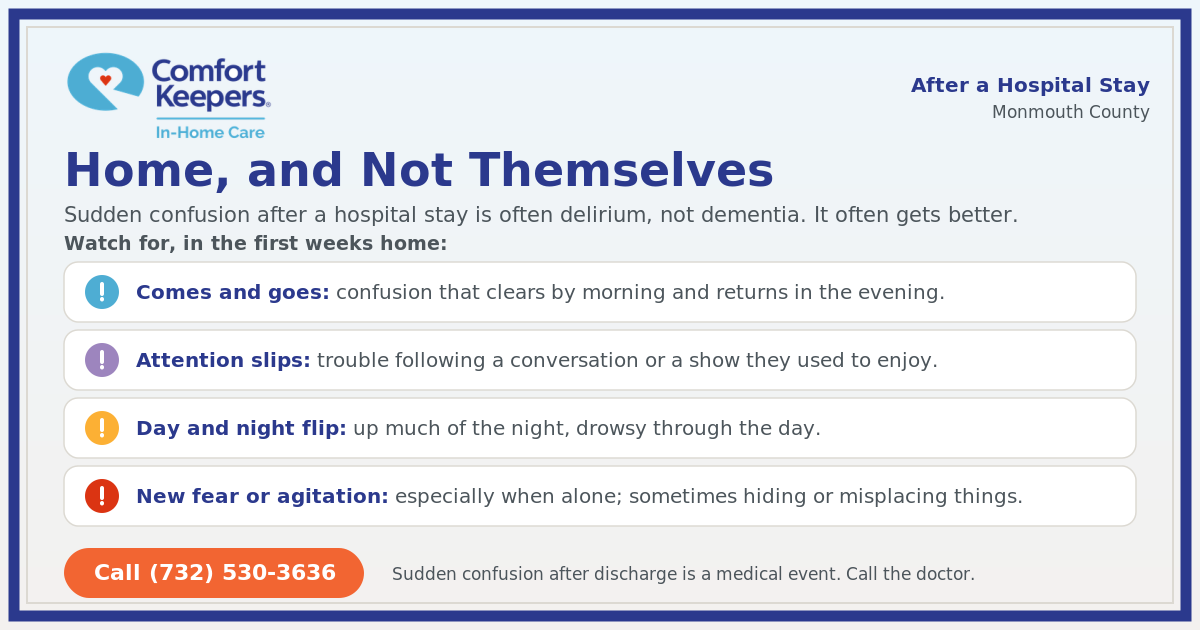
The two get confused because they can look identical across a kitchen table. The tell is the timing. Dementia comes on slowly, over months and years, and it holds fairly steady day to day. Delirium comes on fast, over a day or two, and it swings, worse in the evening, clearer in the morning. A mother who was completely herself last week and is suddenly, dramatically confused this week is almost certainly showing you delirium, not the slow arrival of dementia.
Brittany Minervini, RN, our Director of Nursing, has walked a lot of Monmouth families through this. Her point is the reassuring one: delirium is usually the body under stress, an infection, dehydration, a new medication, a week of broken sleep in a strange room, and when the trigger is found and treated, the fog often lifts. It is a medical event, not a personality change, and it should never be shrugged off as "she's just getting older."
What a caregiver in the room is actually doing
Here is the part that surprises families. The care that helps most is not high-tech. It is a handful of small, ordinary things done by someone who is there and paying attention.
A good caregiver makes sure the hearing aids are in and the glasses are on, so your mother is not decoding a blurry, muffled world on top of her confusion. She keeps the water within reach and actually prompts the sips, because an older adult who cannot feel thirst gets dehydrated fast and dehydration deepens the fog. She gets your mother up and moving during the day and protects a real night's sleep, so the flipped day-and-night cycle that feeds delirium starts to right itself. She keeps the day oriented, the calendar visible, the routine familiar. None of it looks dramatic. All of it is what tips a recovering brain back toward clear.
And she watches. A caregiver who is in the home enough to know your mother's normal is the one who notices the new spike of confusion, the low-grade fever, the appetite that fell off, and says something before it becomes another ambulance ride. We had a caregiver catch exactly that, a returning infection showing up first as a bad afternoon, and a phone call to the doctor turned it into a prescription instead of a readmission.
The first two weeks home are critical
Delirium does not always clear the day of discharge. It can hang on for days or weeks while the body recovers, and those first weeks home from Riverview in Red Bank, Monmouth Medical Center in Long Branch, or Jersey Shore University Medical Center in Neptune are when a parent is most likely to steady, or to slide backward. What happens in the house tips the odds. A calm, predictable routine, good sleep, steady hydration, someone catching a returning infection early, that is the difference between a full recovery and a lasting loss. An episode is not harmless: a 2020 analysis in JAMA Neurology found delirium is an independent risk factor for long-term cognitive decline, even after accounting for the illness that caused the stay, which is why clearing it early matters so much. The encouraging part is how preventable it is. The Hospital Elder Life Program, built by Harvard geriatrician Dr. Sharon Inouye and now used in more than 200 hospitals, cut new delirium by about 40 percent in a landmark New England Journal of Medicine trial, using nothing more than the ordinary, non-drug steps above: orientation, glasses and hearing aids, hydration, movement during the day, and protected sleep. Every one of those is exactly what a good caregiver does in the home.
When a family sets up care after a discharge, Brittany writes a plan built around these specific risks, and your Client Care Coordinator, Paula Fleming, matches a caregiver who can hold the routine steady through the shaky weeks.
Falls are part of the same risk. A parent who is weak and a little confused is more likely to fall in those first weeks, especially getting up at night. Our guide on preventing falls at home covers night lights, the walk to the bathroom and what to ask the doctor.
Who we send into a recovery like this
For a parent this vulnerable, the question of who walks in the door matters more than usual. Every caregiver we send is a certified home health aide, and our human resource manager, Deborah Hing, treats the background check as the minimum, not the measure: she calls each caregiver's references herself before hiring, and we keep a history on every caregiver across every home over time. For a delirium recovery we match on that history, someone steady, observant, and experienced with older adults coming off a hard hospital week, not just whoever happens to be available.
When to call the doctor, and what we can't promise
We are not doctors and we do not diagnose. Sudden confusion, a change in alertness, hallucinations, or a personality shift in an older adult, especially right after a hospital or rehab stay, is a call to their physician, not something to wait out. What we can promise is a caregiver who knows what delirium looks like, keeps the small things right, and flags a change to you and the doctor early. And if what you are describing sounds like more than delirium, we will say so and point you toward the right help.
If your mother or father came home from a Monmouth County hospital confused and not quite themselves, and you are not sure what you are looking at, call us and we will talk it through. We have this conversation often, and there is no obligation to use us.
Call us at (732) 530-3636.