

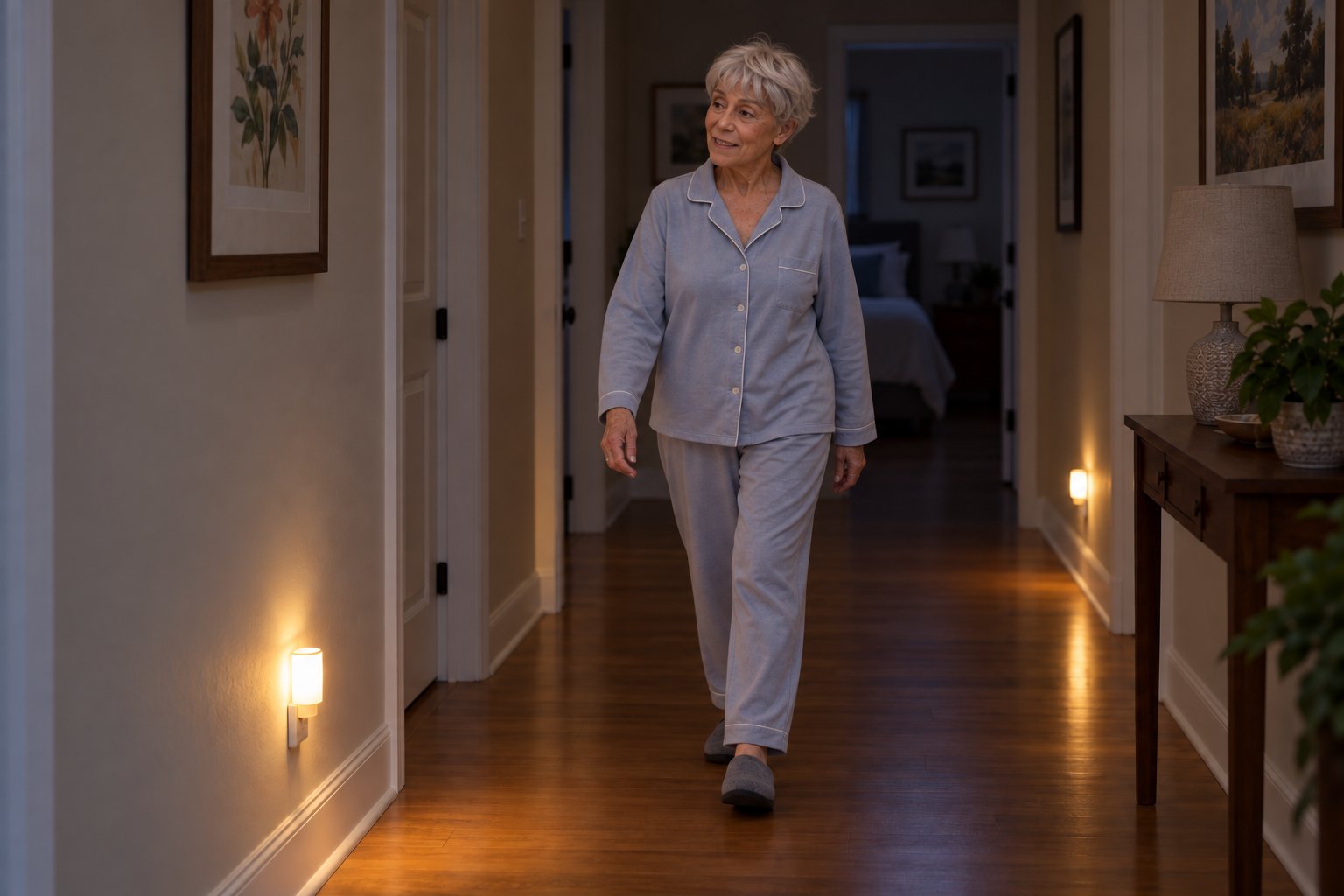
Can you really stop an aging parent from falling? Not every time. But most falls at home trace back to a short list of things a family can work on: weaker legs and balance, medications, eyesight, blood pressure that drops when she stands up, and a house that has quietly gotten harder to get around. Fix a few of them and the odds go down. Early autumn is a good time to start.
The numbers are close to home. In 2024, hospitals treated 8,199 Monmouth County adults age 60 and older in the emergency room for a fall and admitted 1,843 more, according to New Jersey's Division of Aging Services. That's about 27 people a day. Nationally, the CDC reports that more than one in four older adults falls each year, and that falling once doubles the chance of falling again.
What autumn in Monmouth County changes
Nothing about October makes your mother's legs any weaker. What changes is the light. Sunset comes a little earlier every week, and by December it's dark before dinner. Suddenly the evening pills and that last trip to the bathroom all happen in the dark.
Outside, wet leaves pile up on front steps and driveways from Middletown to Tinton Falls, and the first frost tends to show up on a walkway before anyone has thought about salt. So the work that matters most right now is about light, and about the hours after dinner.
Start with the walk from the bed to the bathroom
If you fix only one thing, fix this one. Getting up at night to use the bathroom is one of the riskiest moves of the day for an older adult. She's half awake, the room is dark, and she may stand up faster than her blood pressure can keep up.
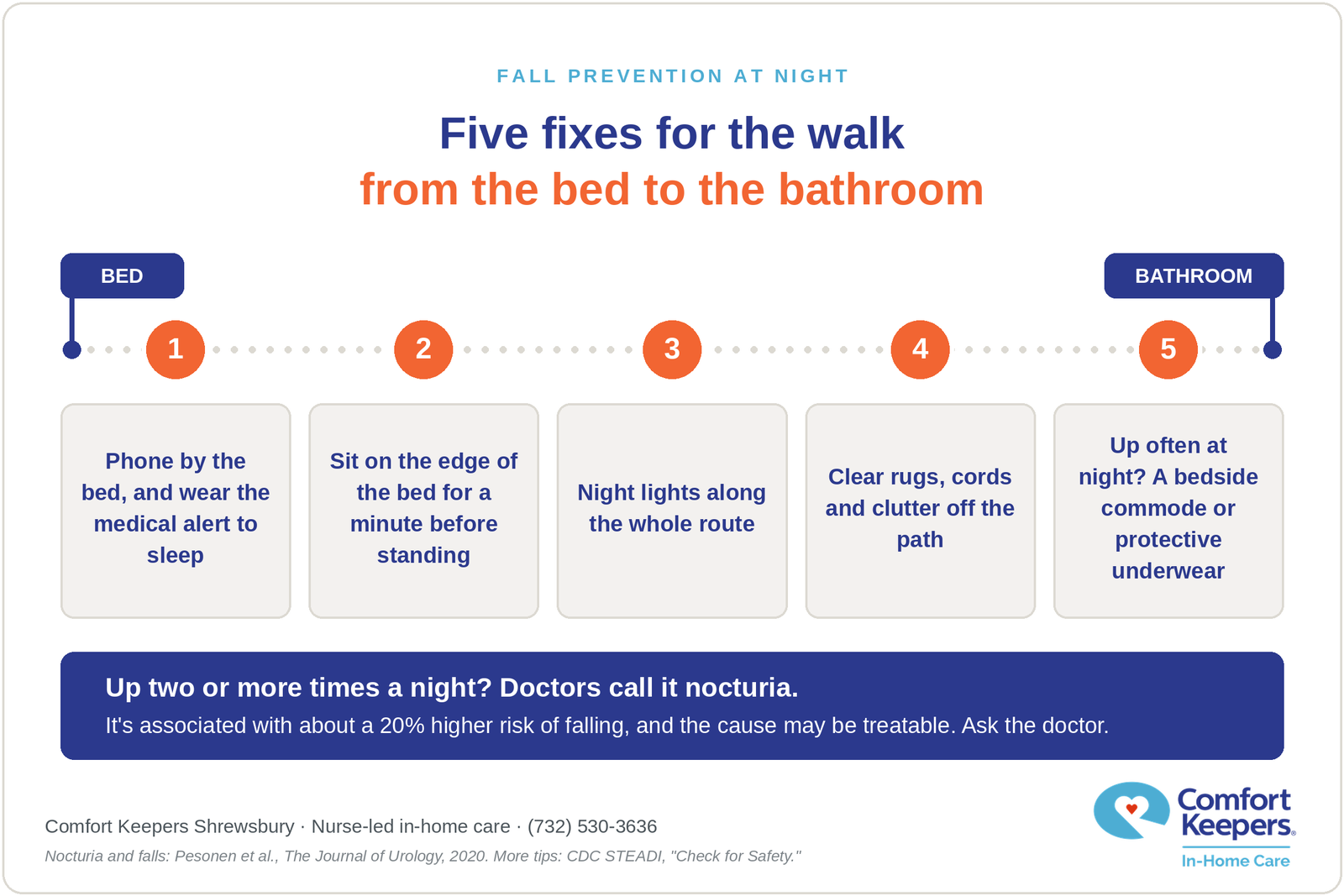
- Put plug-in night lights or motion-sensor lights along the whole route, from the bedroom to the toilet.
- Keep the phone within reach of the bed instead of charging in the kitchen. If she has a medical alert, it goes to bed with her. It only helps if she's wearing it.
- Have her sit on the edge of the bed for a minute before she stands. A drop in blood pressure on standing is common, and it can cause dizziness.
- Clear the path of throw rugs, cords, laundry baskets and the dog's bed.
- Ask her doctor whether a bedside commode makes sense for now.
One more thing we see: some parents quietly stop drinking in the afternoon so they won't have to get up at night. That trades one problem for another. Too little fluid can leave her dizzy and more likely to fall, and it raises the risk of a urinary tract infection. Staying adequately hydrated matters. Ask her doctor whether shifting fluids earlier in the day would help.
If she's up two, three or four times a night, that's worth its own conversation with her doctor. Waking up more than once a night to use the bathroom has a name, nocturia, and a 2020 review in the Journal of Urology found it was associated with about a 20 percent higher risk of falling. The sudden can't-wait feeling, which doctors call urgency, is what sends people hurrying through a dark house. The cause may be something that can be treated, like a urinary tract infection, an overactive bladder, an enlarged prostate or the timing of a water pill. Until it's sorted out, a bedside commode or protective underwear at night means she doesn't have to rush.
The fixes that matter, room by room
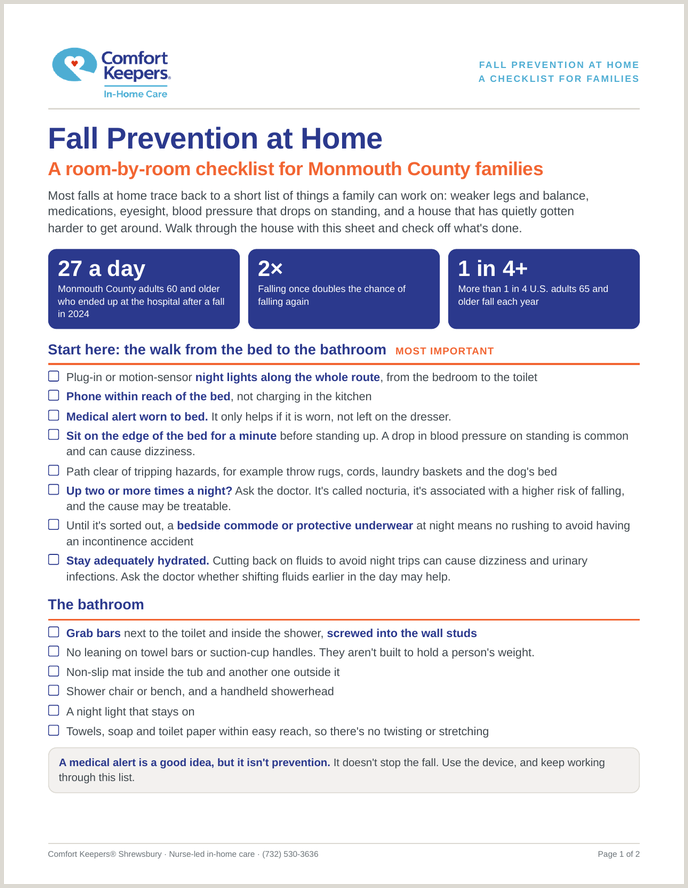
Print the fall prevention checklist
Two pages to print and check off room by room: the night-time fixes, the room-by-room list, and the questions to bring to the doctor.
The bathroom comes first. Grab bars belong next to the toilet and inside the shower, screwed into the wall studs. Towel bars and suction-cup handles aren't built to hold a person's weight, but they're exactly what people reach for when they slip. One wife told us her husband slipped on the bath towel stepping out of the shower, and she had been picking him up off the floor herself. A non-slip mat inside the tub and another outside it, a shower chair and a handheld showerhead take care of most of what goes wrong in there.
If your parent is worried grab bars will hurt the house when it's time to sell, that's a fair question. Plenty of grab bars now look like ordinary towel bars, and they can come out later.
Stairs need a sturdy rail on both sides and good light at the top and the bottom. Nothing gets left on the steps, not even for a minute. If the bedroom is upstairs and the falls have already started, moving the bedroom downstairs is worth the argument.
In the kitchen, move the everyday dishes and food to shelves between waist and shoulder height, so there's no step stool and no reaching. At the front and back doors, put the outside light on a timer or a sensor, keep the leaves swept off the steps, and add a railing where there isn't one.
The CDC's Check for Safety checklist walks through every room in more detail. It's worth printing and bringing on your next visit.
Socks, shoes and the walker in the corner
A lot of falls start at floor level. A niece told us her uncle's sock slid out from under him and he landed on his back with a compression fracture. Socks, loose slippers and backless shoes are easy to overlook. A closed, flat shoe with a non-slip sole, worn inside the house, is one of the cheapest changes you can make.
Then there's the walker. If your parent has one and won't use it, you have plenty of company. It usually isn't about the walker. It's about what the walker says to her. Let her pick one she likes the look of. Ask the doctor or physical therapist to make the recommendation instead of you. And start with the places she feels least steady, like the trip to the bathroom at night.
Strength, balance and what to ask the doctor
Legs and balance weaken with age, and a good part of that can be built back. Tai Ji Quan, a balance program based on tai chi, and A Matter of Balance are both offered through county Offices on Aging, according to the New Jersey Division of Aging Services. A physical therapist can also set up exercises she can do at home. Check with her doctor before she starts anything new, especially after a recent fall or a hospital stay.
Closer to home, SCAN, the Senior Citizens Activities Network, runs exercise and balance classes for adults 55 and older at the Church of the Precious Blood Parish Center in Monmouth Beach and in a community room at Boscov's in Eatontown. The fall 2026 lineup includes Tai Chi, Chair Yoga, Sit and Get Fit, and a strength class called Strong Body Strong Bones. Many sessions can also be joined on Zoom, which helps a parent who no longer drives. The semester runs through early December, and SCAN's class listing has the days, times and fees.
Bring up the fall at that appointment even if she wasn't hurt. The CDC says less than half of older adults who fall tell their doctor. Ask for a fall-risk check, a review of every medication (sleep aids, blood pressure pills and some pain medicines can all cause dizziness) and a vision check. Ask about bone density, too. Thinning bones, or osteoporosis, are why a fall a younger person would walk away from can break a hip. If dizziness keeps coming back, an inner-ear problem, which doctors call a vestibular disorder, may be worth a look.
A sudden run of falls, especially with new confusion, is worth a call to the doctor the same day. We're not diagnosing anyone, but we see infections like UTIs behind sudden changes often enough that we always ask. If your parent has dementia or Parkinson's, the late-day hours can bring more confusion and more unsteadiness. Our page on managing sundowning at home covers what helps in the evening.
A medical alert is a good idea. It isn't prevention.
Many families start with a pendant or a smartwatch with fall detection, and that's a reasonable first step. It tells someone she fell. It doesn't stop the fall, and it only works when she's wearing it. Too many families find out it was sitting on the dresser the one night she got up for the bathroom. Use the device, and keep working on everything above.
When Mom won't take any of this seriously
This is where a lot of families get stuck. She hides the fall. She won't wear the pendant. She insists the house is fine. Dad won't hear a word about moving his bedroom downstairs.
Pushing harder rarely works. What does help is making it her decision, starting smaller than you think you need to, and letting someone other than her son or daughter make the case. Some families agree to a trial: try it for a month or two, then decide together. When a parent won't hear it from her own children, we can send one of our nurses out to talk with her. It lands differently coming from someone who isn't her kid.
And if she fell while you were there, or while you were away for the weekend, you didn't do anything wrong. People can just fall. It happens fast, and nobody can watch every step.
When prevention needs a second set of hands
For some families, the changes above are enough. For others, the gap is time. Nobody is there at six o'clock when the light goes, or at bedtime, or first thing in the morning. That's where a caregiver helps most. On an evening visit, a caregiver can get the lights on before dark, help with dinner and the shower, set out tomorrow's shoes, walk with your parent to the bathroom before bed, and make sure the phone is on the nightstand. Our page on personal care covers the day-to-day help in more detail.
Once care starts, the in-home assessment includes a walkthrough of the house. Our experienced Director of Nursing, Brittany Minervini, RN, uses it to help the family make the home safe for both your parent and the caregiver. Those details go into the Plan of Care. After that, your Client Care Coordinator is the one person to call when the schedule needs to change or something in the home isn't working.
The first few weeks after a hospital stay are when this matters most. If your parent is coming home from Riverview Medical Center or Monmouth Medical Center after a fall, she may be weaker than before. She may also be more confused for a while. Our article on delirium after a hospital stay explains why.
There's a limit worth knowing up front. A caregiver can't prevent a fall during the hours nobody is there. If your parent is falling often or can't safely be left alone, the conversation turns to longer shifts or live-in care, and we'll tell you plainly which one fits.
Medicare usually doesn't pay for this kind of help. Its home health benefit covers part-time skilled care, like nursing or therapy, for people who qualify as homebound. Medicare.gov is clear that it doesn't cover 24-hour care at home, or personal care like bathing when that's the only care needed. Most families pay privately, through long-term care insurance, or with VA benefits if a parent or spouse served.
A word from me
My staff and I have these conversations all day long, and a lot of them start with a fall, or with the fear of one. I also serve on SCAN's board, because keeping older adults active and connected is a big part of keeping them safe at home. If your parent has had a close call, or you just have a bad feeling about the stairs, call us at (732) 530-3636. The no-cost consultation can happen by phone or at your parent's home, whichever is easier. We'll talk through what you're seeing and what would make the house safer, and whether a few hours of help makes sense right now. We'll give you a cost on that call too, and there's no obligation to use us.
Take the checklist with you
Print it, put it on the fridge, and share it with the rest of the family.
Questions families ask about fall prevention
What are the most common causes of falls in older adults?
Usually several things at once: weaker leg muscles and balance, medications that cause dizziness or drowsiness, changes in vision, blood pressure that drops when standing, and hazards at home like loose rugs and dim lighting. The CDC notes that falling once doubles the chance of falling again, so even a minor first fall is a good reason to review all of these with her doctor.
How do I make my parent's bathroom safer?
Install grab bars screwed into the wall studs next to the toilet and in the shower. Suction cups and towel bars won't hold a person's weight. Add a shower chair and a handheld showerhead, non-slip mats inside and outside the tub, and a night light that stays on. Keep towels, soap and toilet paper within easy reach so she isn't twisting or stretching.
Should my parent tell the doctor about a fall if she wasn't hurt?
Yes. According to the CDC, less than half of older adults who fall tell their doctor, yet one fall doubles the chance of another. A fall without an injury is still a warning sign. Ask the doctor for a fall-risk check, a medication review and a vision check, and whether physical therapy makes sense.
Is a medical alert device enough to prevent falls?
No. A medical alert tells someone she fell, but it doesn't prevent the fall, and it only helps if she's wearing it. Many families learn she wasn't at the worst moment, getting out of bed at night. Use one, and pair it with better lighting, grab bars, proper footwear, strength and balance exercise, and help during the riskiest hours.
Does Medicare pay for help at home to prevent falls?
Generally not for ongoing help. Medicare's home health benefit covers part-time skilled care, like nursing or therapy, for people who qualify as homebound. It doesn't cover 24-hour care, or personal care like bathing and dressing when that's the only care needed. Families usually pay for in-home care privately, through long-term care insurance, or with VA benefits if they're eligible. Comfort Keepers in Shrewsbury can walk you through the options at (732) 530-3636.