

Here is the thing almost nobody tells families: an older adult can be well into mild dehydration before they ever feel thirsty. The first real heat wave usually rolls into Gloucester County in late June or early July, and by the time the weather folks are warning about it on the evening news, the seniors most at risk are often already two or three days behind on fluids. That is the part families do not see coming. You are not failing anyone by missing it. The thirst signal just stops being reliable with age, and so do the body's sweat response and its ability to cool itself, while several common medications quietly make all three worse.
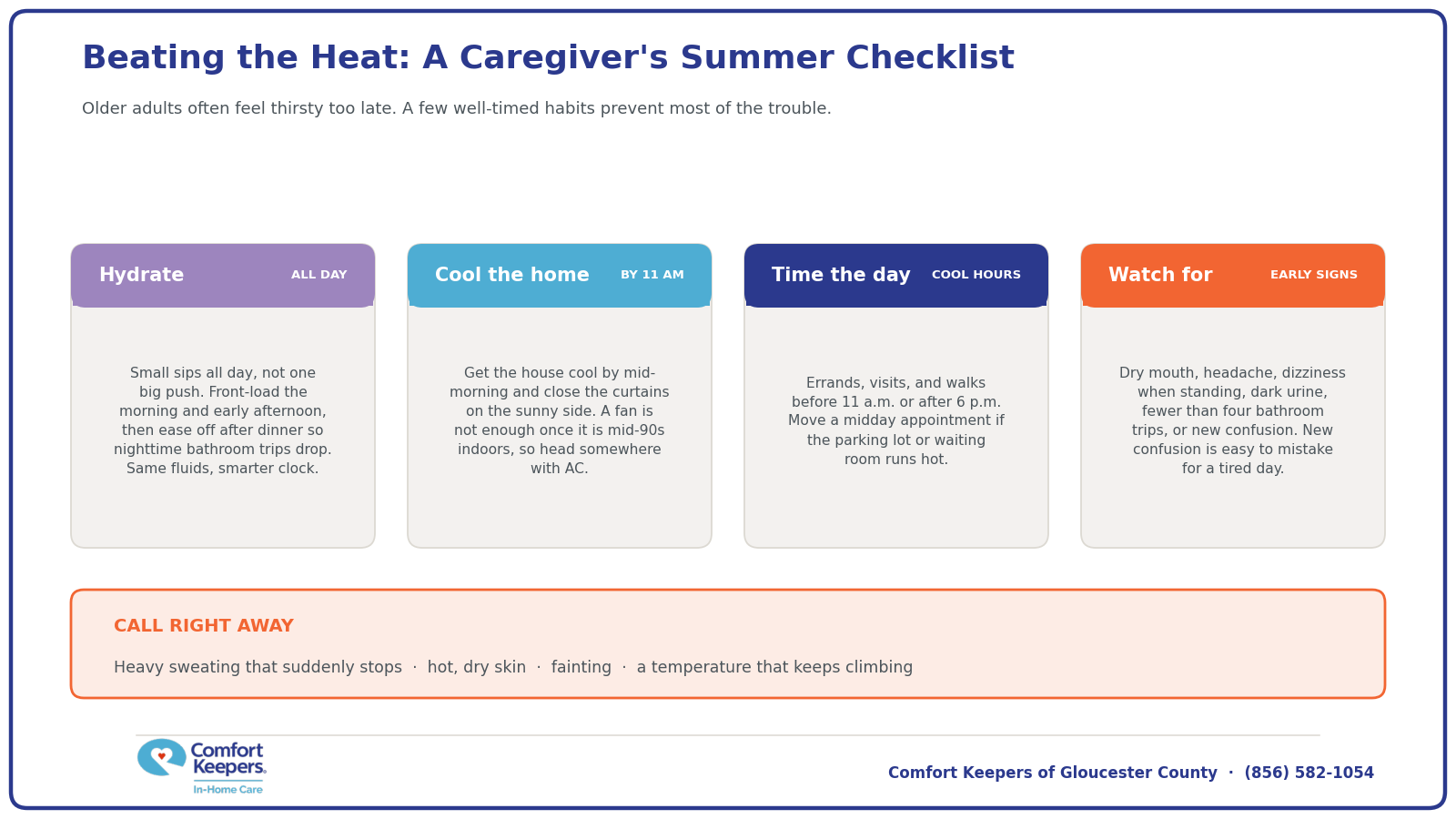
That is why the rest of this comes down to a few habits rather than one big rule. Hydrate in small amounts all day instead of big gulps. Get the home cool by mid-morning. Keep errands and visits to before 11 a.m. or after 6 p.m. Dress light and loose. Watch for dry mouth, headache, dizziness, dark urine, and new confusion. Our caregivers can be the steady presence through the hottest stretches, and the sections below walk through each piece.
Why older adults are more at risk
The CDC's page on heat and older adults walks through the physiology. Aging blunts thirst, so seniors often do not feel thirsty even when they need fluids. Aging slows sweating, which is the body's main cooling system. Common medications, especially water pills and some blood-pressure drugs, increase fluid loss and can interfere with temperature control. Heart disease, kidney disease, and dementia raise the risk further.
The National Institute on Aging covers hot-weather safety for older adults too. The warning signs to watch for include heavy sweating that suddenly stops, hot dry skin, headache, dizziness, nausea, fainting, and confusion. That last one matters. New confusion in a heat wave can be a heat-stress signal, and families miss it because they chalk it up to dementia or to "just a tired day."
The hydration mistake families make
Here is the counterintuitive thing I wish more families knew. The problem usually is not that a senior refuses to drink. It is when they drink.
A lot of older adults quietly cut back on fluids in the afternoon and evening on purpose, because they are afraid of getting up to the bathroom at night and falling in the dark. That fear is reasonable. The fall risk at 2 a.m. is real. But the fix is timing, not going dry. We front-load the day: a real push on fluids through the morning and early afternoon, then easing off after dinner so the bathroom trips happen before bed instead of at three in the morning. Same total fluids, smarter clock. That one change prevents a lot of the late-day dehydration that lands seniors in the Inspira Woodbury emergency room in July.
For the rest of it, spread fluids across the day in small amounts. A drink with breakfast, mid-morning, lunch, and mid-afternoon, then taper. Water is the default, and watered-down juice, milk, decaf tea, soup, gelatin, and watermelon all count. Coffee and alcohol work against the goal. If your loved one is on a fluid restriction for a heart or kidney reason, follow the doctor's number, not the general guideline.
When heat warnings hit Gloucester County: the home
By ten or eleven in the morning, the home should be cool. Air conditioning is the right answer when it is there. If the home has no AC, the safest plan on a bad day is to spend the hottest hours somewhere that does, a senior center, the Gloucester County library, a relative's place, or a mall.
One thing families get wrong: a fan is not a cooling system once it gets truly hot. The National Institute on Aging and the EPA both advise against relying on a fan when the room is in the mid-90s or hotter, because at that point a fan just moves hot air across the skin and can add to heat stress instead of relieving it. Below that, a fan helps, and it helps more when your loved one is also drinking water. Close the curtains on the sunny side of the house by mid-morning, and open the windows early and again after sunset once the air has cooled.
The schedule and the medications
Errands, appointments, and visits belong in the cooler hours, before 11 a.m. or after 6 p.m. A doctor's appointment booked for the middle of a hot day is worth moving if the waiting room runs warm or the parking lot means a long walk across hot asphalt. Porch sitting, a short walk, and the garden are all safer in the early morning and the evening.
If your loved one is on a water pill or another medication that affects fluid balance, the timing matters, and it ties right back to the afternoon-hydration issue. Many families work with the prescribing doctor to take the morning water pill earlier, so the bathroom trips happen before the day's heat sets in. That is a conversation with the doctor, not a change to make on your own.
What our caregivers do through the hottest weeks
Our compassionate caregivers are the steady presence a working family cannot always be during the day. The cup of water at mid-morning. The reminder to close the curtains. The walk to the mailbox at 7 a.m. instead of noon. The light lunch, the afternoon rest, and the early call to the doctor when something looks off. We have caught early dehydration more than once simply because the same caregiver was there every day and noticed the person was a little foggier than usual.
When heat-stress risk is part of the picture, our seasoned Director of Nursing, Lynn Guice, RN, leads the in-home Assessment and builds the Plan of Care, which she reviews at 30 and 60 days. Your dedicated Client Care Coordinator, one of our attentive office leads like Charice "CC" Creecy, handles scheduling and the day-to-day, so you are always talking to someone who knows your family. If you want help, we are glad to set up a few hours of companion care or steady help with personal care through the worst of the summer.
Frequently Asked Questions
How much water should an older adult drink in summer?
For most older adults, small amounts spread across the day works better than a big push at noon. If your loved one has a fluid restriction for a heart or kidney condition, follow the doctor's number instead. The bigger lever is timing: most fluids in the morning and early afternoon, easing off after dinner so nighttime bathroom trips and the fall risk that comes with them are fewer.
Is a fan enough on a really hot day?
Not once it gets into the mid-90s indoors. The NIA and EPA advise against relying on a fan at that point, since it moves hot air without cooling the body and can make heat stress worse. Air conditioning, or a few hours somewhere cool, is the safer answer on the worst days.
What are the warning signs we should call the doctor about?
Dry mouth, headache, dizziness when standing, dark or strong-smelling urine, fewer than four bathroom trips a day, new confusion, and unusual fatigue. Heavy sweating that suddenly stops, hot dry skin, or fainting means call right away. New confusion in particular is easy to miss, because families assume it is dementia or tiredness when it can be heat stress.
Does Medicare pay for a caregiver in the summer?
Medicare does not pay for non-medical home care. Long-term care insurance often does, and we file that paperwork for you and bill the carrier directly. Call us and we will talk through the funding paths that fit your situation.
Is your office NIHCA-accredited?
Yes. Our Pitman office is NIHCA-accredited and uses the Interactive Caregiving™ model.
Talk to us
If you are worried about how a hot summer is going to go for an older adult in Pitman, Sewell, Washington Township, Mullica Hill, Glassboro, Woodbury, or anywhere in Gloucester County, give us a call at (856) 582-1054. You will reach our office, and the first conversation is no-cost. Tell us what your summer looks like, and we will help you figure out whether a few hours a week is enough or whether something steadier makes sense. Our work is to elevate the human spirit, one home and one family at a time.







