

A month-by-month guide for families.
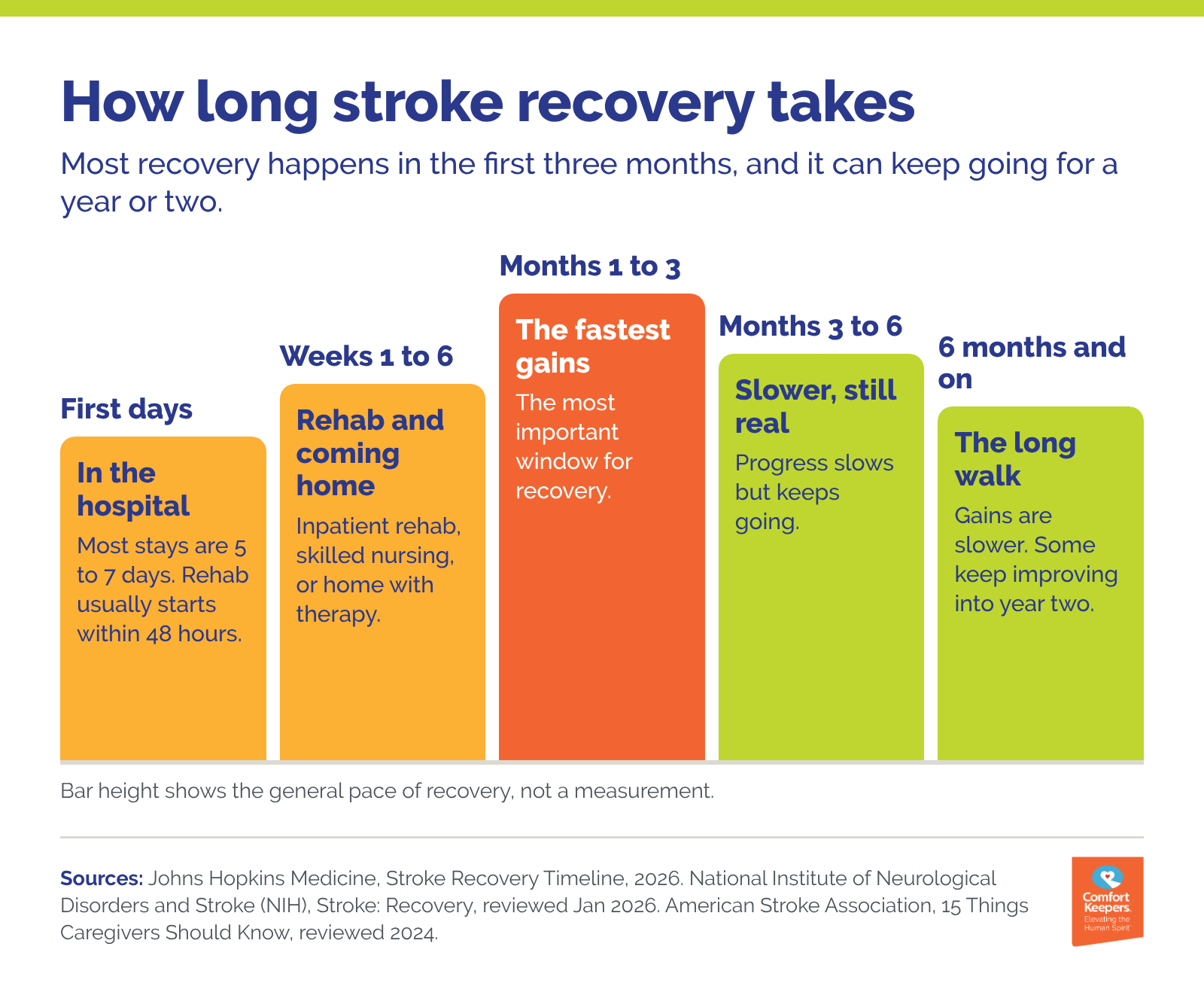
Most of the recovery after a stroke happens in the first three months, and it can keep going for a year or two after that. Johns Hopkins Medicine says the most noticeable recovery "usually happens during the first three months," and that progress slows after six months but "can continue for many months or years." The American Stroke Association says some survivors "continue to recover well into the first and second year."
How much comes back is different for everyone. What the family does in those months matters: getting to therapy, practicing between sessions, and catching small problems before they become setbacks.
In Gloucester County, families have counted on our locally owned Pitman office since 2007, under a Comfort Keepers name that dates to 1998. After a stroke, we help with the months after the hospital and rehab are done.
What decides how much someone recovers from a stroke?
How much someone recovers from a stroke depends mostly on the size and location of the brain injury. NINDS says lasting disability "depends on the size of the brain injury and the specific parts of the brain that are damaged." The American Stroke Association adds factors the family can actually affect: the survivor's motivation, support from caregivers, and how much rehab they get and how good it is. Health before the stroke matters too.
The first days: in the hospital
The first days after a stroke are spent in the hospital. Johns Hopkins Medicine says most people stay five to seven days. Rehabilitation starts fast: NINDS says it "usually first takes place in the hospital within 48 hours of a stroke."
Our Pitman page on planning before a hospital discharge covers the questions to ask.
Weeks one to six: rehab and coming home
After the hospital, people move on to one of four places: an inpatient rehab, a skilled nursing facility, home with outpatient therapy, or home with home-based therapy, according to NINDS. Which one depends on how much help someone needs and how much therapy they can handle each day.
Once someone is home, the house has to be ready for them, starting with the bathroom at night.
Months one to three: the fastest gains
Months one to three after a stroke are when recovery moves fastest. Johns Hopkins calls the first three months "the most important for recovery" and says "this time is considered the critical period." Some of what comes back in these weeks returns on its own as the brain heals, and therapy builds on it.
Protect this stretch. Get to every therapy session, do the home exercises every day, and watch mood: of all the depression that shows up in the first year after a stroke, 71% starts by the three-month mark, according to a 2023 meta-analysis in PLOS Medicine (Liu et al.).
Months three to six: slower, still real
From about three to six months after a stroke, recovery usually slows, but it doesn't stop. Johns Hopkins says that "after six months, improvements are possible but are likely to be slower."
Boredom sets in here. Adapt what you can: cards with a holder, music, short walks, a ride to see friends, the Phillies on the radio instead of squinting at the screen. If words are still a struggle, that's common; NIDCD, part of the NIH, says roughly one in three people who survive a stroke has aphasia. Edison's page has the NIH tips for talking with someone who has aphasia.
After six months: slower, still possible
After six months, progress is slower, but it can continue with steady practice and support. Small, fixable problems can stall it.
A story from one of our attentive caregivers, Roberta, shows how. The man she cared for hadn't had a stroke, but the lesson carries over. He had stopped watching his sports in the afternoon, and it would have been easy to put it down to mood. "He couldn't see the TV and it made him sad," she told us. "We got him better glasses and he was better."
A plateau isn't always the brain. Sometimes it's glasses, a hearing aid, a pill that makes someone sleepy, or a chair too low to get out of. Somebody has to notice.
Three things that often set stroke recovery back
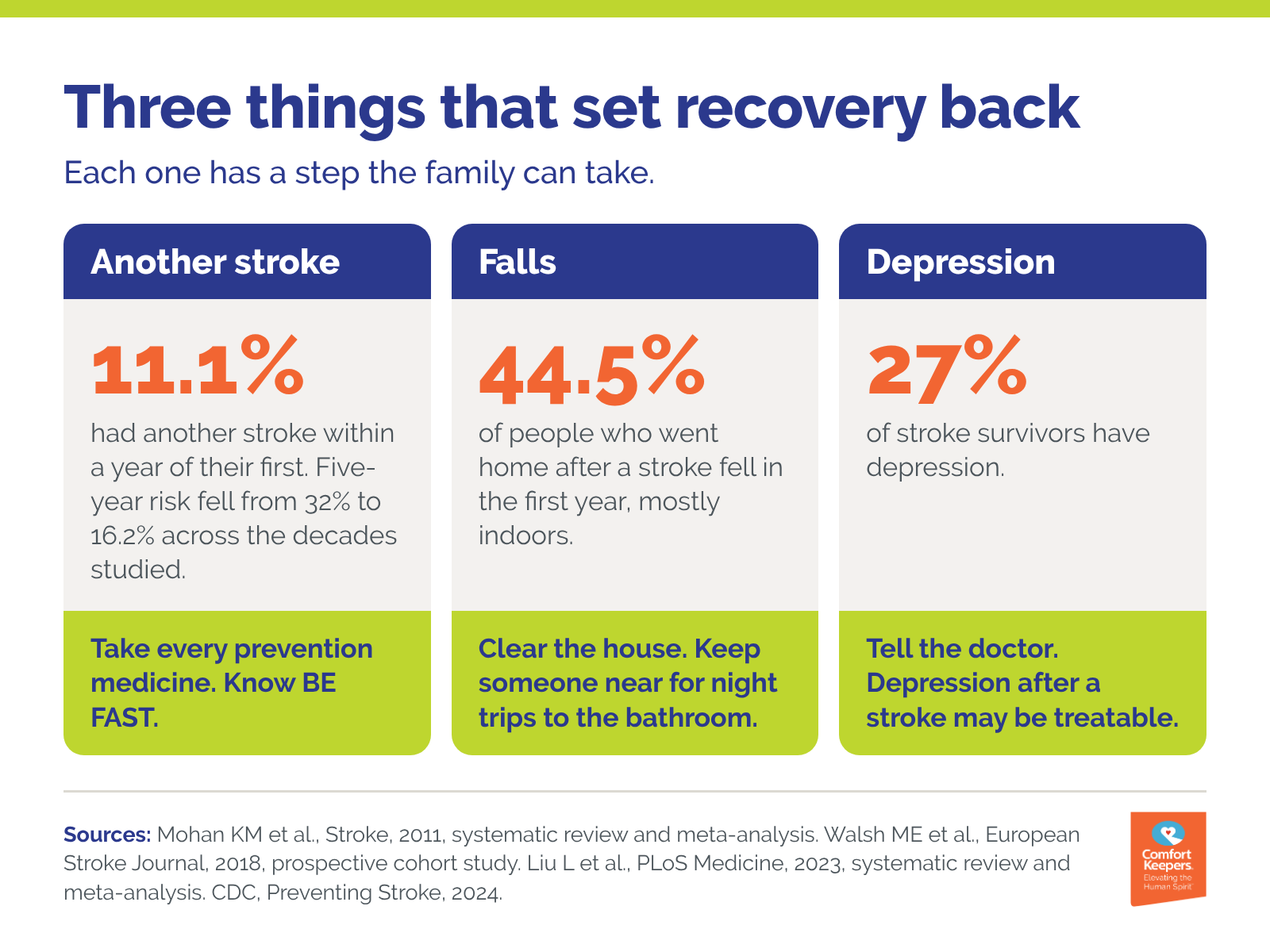
Three things that often set stroke recovery back are another stroke, a fall, and depression.
- Another stroke. A meta-analysis in the journal Stroke (Mohan et al., 2011) found the risk of another stroke was about 3.1% in the first 30 days, 11.1% in the first year and 26.4% within five years. The same study found the five-year risk fell from 32% to 16.2% across the decades studied. What to do: take every prevention medicine, and know the warning signs.
- Falls. In a study of 128 people who went home after a stroke (Walsh et al., European Stroke Journal, 2018), 44.5% fell in the first year, 25.6% fell more than once, and most falls happened indoors. What to do: fix the house, and have someone nearby for the risky trips. Our room-by-room fall prevention checklist is a good place to start.
- Depression. The same 2023 review found depression in about 27% of stroke survivors, and of people depressed within the first three months, 53% were still depressed later. What to do: say it out loud to the doctor, because depression after a stroke may be treatable.
How to lower the risk of a second stroke
Lowering the risk of a second stroke comes down to the same steps the CDC lists for preventing any stroke: control blood pressure, cholesterol and diabetes, treat heart disease including atrial fibrillation, and don't smoke. After a stroke, the CDC adds: "Never stop taking your medicine without first talking to your doctor or pharmacist."
The CDC counts nearly 1 in 4 U.S. strokes in people who had one before. Shrewsbury's page covers the stroke warning signs.
Stroke in Gloucester County
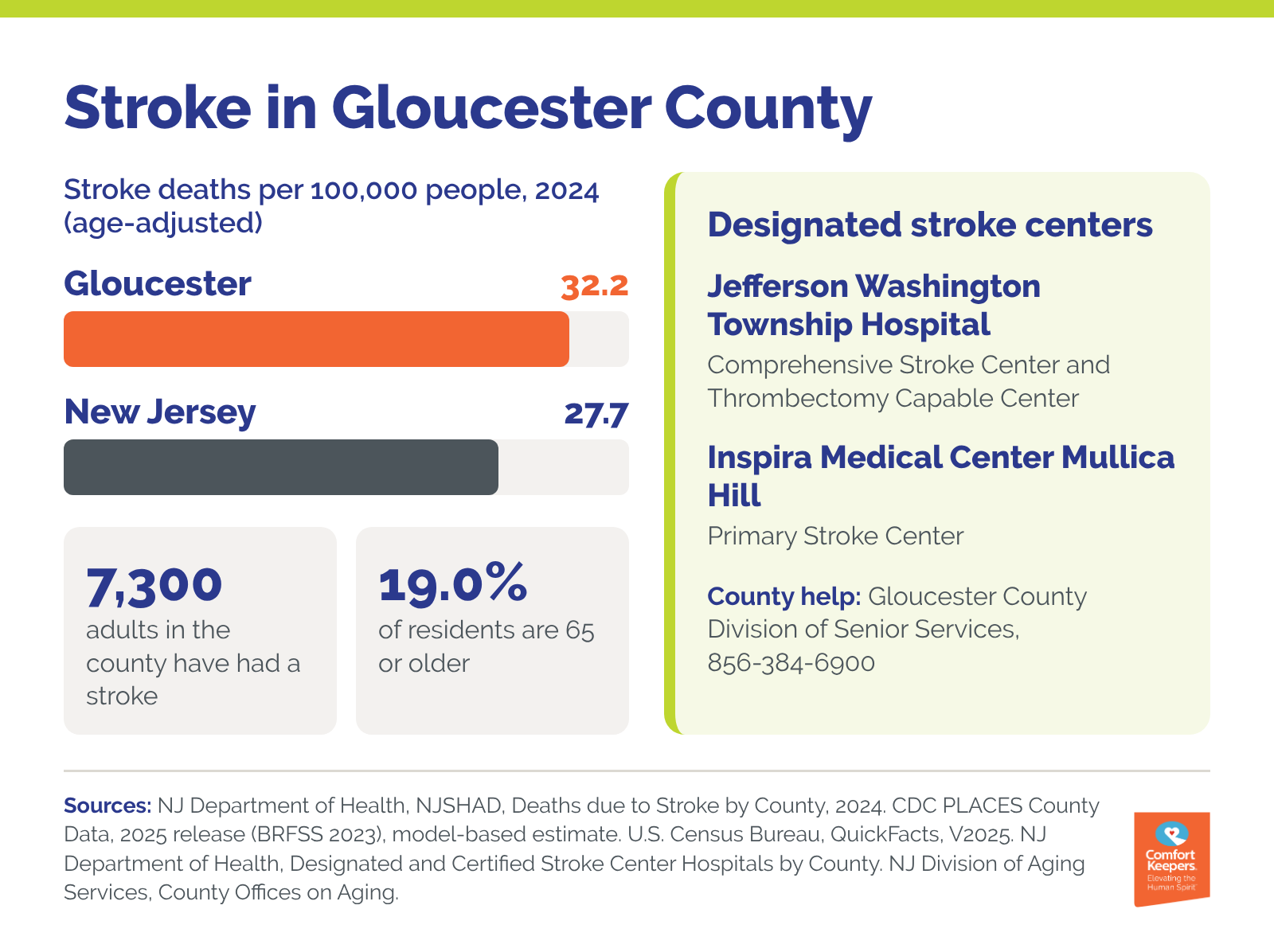
Gloucester County's stroke death rate was above New Jersey's in 2024. The county had 119 stroke deaths, an age-adjusted rate of 32.2 per 100,000, compared with 27.7 statewide (NJ Department of Health, NJSHAD). About 7,300 Gloucester County adults have had a stroke, by the CDC's PLACES estimate, and nearly one in five residents (19.0%) is 65 or older, Census data show.
The state health department has designated two Gloucester County hospitals as stroke centers. Jefferson Washington Township Hospital, in Washington Township, is a Comprehensive Stroke Center and is also certified as a Thrombectomy Capable Center. Inspira Medical Center Mullica Hill is a Primary Stroke Center.
For help finding programs, call the Gloucester County Division of Senior Services at 856-384-6900, or the statewide NJ Aging and Disability Resource Connection at 1-877-222-3737. The American Stroke Association has a Support Group Finder for local stroke groups.
How our caregivers keep recovery moving
Our caregivers keep recovery moving in the months when therapy tapers off and the family is back at work. They can sometimes drive to outpatient therapy and doctor visits in Glassboro, Sewell, Mullica Hill and Washington Township. We set that up case by case. Day to day, they help with showers, meals and the home exercises, and they notice small changes the way Roberta did. Some families start with a live-in caregiver after a serious stroke, and our page on live-in home care in Mullica Hill explains how that works. For family members who need a day off, there's respite care in Gloucester County.
Signs of another stroke mean a 911 call from the caregiver before anything else; we hear next and reach the family. Our Director of Nursing writes the Plan of Care, and Charice "CC" Creecy, our attentive Client Care Coordinator, is the person to call when therapy days move or the hours can finally come down.
Recovery doesn't follow a straight line, and nobody can tell you in month one where it will end. Call us at (856) 582-1054. A conversation with our nurse costs nothing, can happen over the phone, and commits you to nothing.
Download the stroke checklist (PDF)
Recovery questions we hear in Gloucester County
Can you fully recover from a stroke?
How fully someone recovers from a stroke is different for everyone. NINDS says that with treatment and rehabilitation, "most people with stroke are able to recover some function," and how much comes back depends mostly on the size and location of the brain injury.
How long does it take to recover from a stroke at 80?
At 80, the general timeline still applies: the fastest gains in the first three months, then slower progress. The American Stroke Association lists health before the stroke among the factors that shape recovery, along with rehab and support at home.
Is a second stroke likely after a first?
A second stroke is a real risk, especially in the first year. A 2011 meta-analysis in Stroke found about 11.1% of people had another stroke within a year of their first, and 26.4% within five years.
Why are stroke survivors so tired or down?
Tiredness and low mood can be signs of depression, which affects about 27% of stroke survivors. Bring it up at the next doctor visit rather than waiting it out.
When can someone drive again after a stroke?
Someone can drive again after a stroke only when their doctor says it's safe. Until then, family, friends or a caregiver can handle rides to therapy and appointments.
Also from our New Jersey offices: BE FAST and the stroke warning signs from Shrewsbury, coming home after a stroke from Edison, and home care after stroke from Cherry Hill.







