

We had a daughter call us when her mother was being discharged from Inspira Medical Center in Mullica Hill. She was shocked at how confused her mom was. Her mother had never shown anything like this before, and she was afraid it was permanent. After we talked it through, I was able to reassure her that this is fairly common after a hospital stay, and I shared the numbers with her. Together we built a plan. The family could not be there for the first stretch, so at her request we sent a caregiver in a few days before the discharge to sit with her mom a few hours a day, make sure she had her hearing aids in and her glasses on, and get her up and out of bed. She was already a little less confused once someone was there to remind her she was going home soon. Once she got home, the caregiver helped her settle back in, kept her well fed and hydrated, and watched for the warning signs. Within a few weeks her mom made a full recovery. We scaled the care back, and she is still living comfortably in her own home in Pitman today.
Hospital delirium: what is it?
Hospital delirium is a sudden, often dramatic change in a person's mental state that comes on during or right after a hospital stay. It can look like confusion, disorientation, agitation, or a parent who suddenly seems withdrawn and not themselves. It is more common than most families expect, and it is not the same as dementia. It tends to follow the disruptions of a hospital stay: interrupted sleep, new medications, dehydration, a mild infection, an unfamiliar room. The reassuring part is that it is usually temporary. When the triggers are addressed and your loved one recovers at home with familiar routines and someone watching for the warning signs, most older adults return to their old selves within a few weeks.
What hospital delirium is, and what it is not
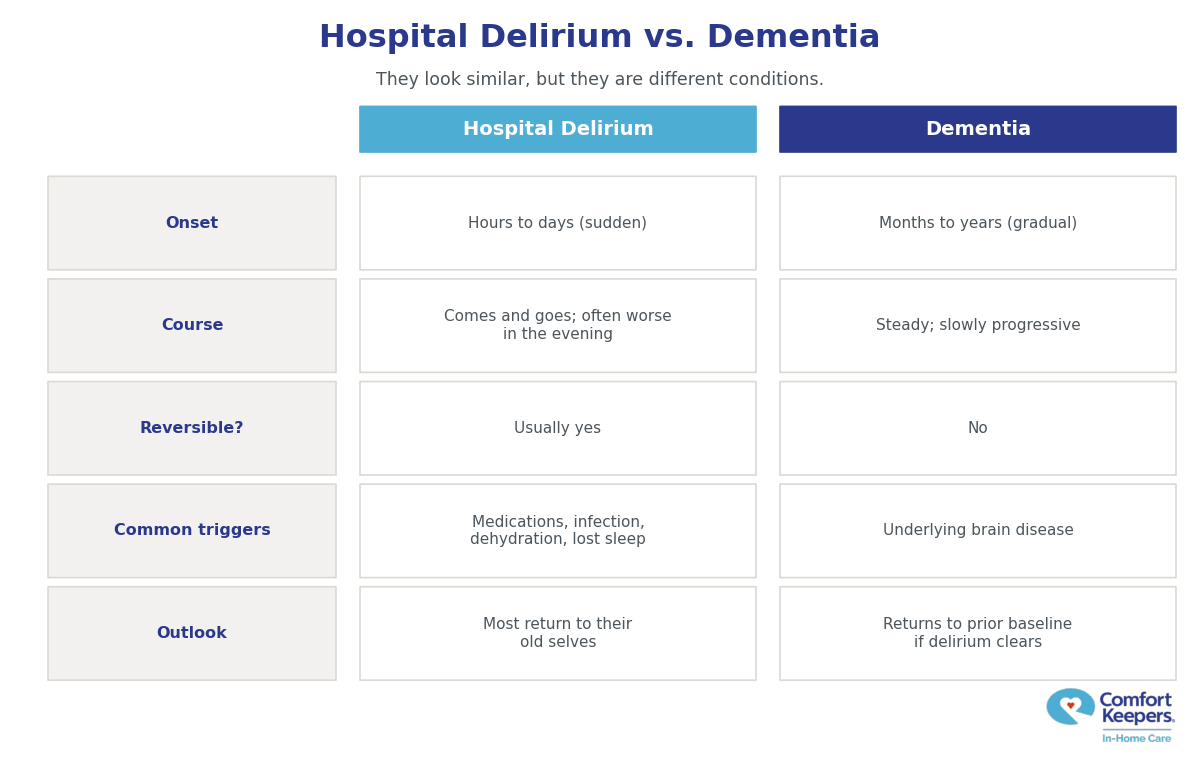
Hospital delirium is a sudden change in mental function: confusion that comes on over hours or a day, not gradually. The Mayo Clinic and the Alzheimer's Association both describe it as a medical event, not a personality change.
The hospital is itself a trigger. Sleep gets disrupted by overnight blood draws and beeping monitors. New medications stack on the usual ones. Mild infections, urinary or respiratory, often present in older adults as confusion rather than as a fever or pain. Dehydration runs steadily through the hospital day. The unfamiliar room and the rotating staff add to it.
Delirium and dementia are different conditions. Dementia comes on gradually over months and years; delirium comes on over hours or days. People with dementia can also develop delirium during a hospital stay, and the picture is often dramatic. The good news: when the triggers are reversed, most delirium resolves. The dementia, if present, returns to whatever baseline it was at before.
Why it matters more after a Gloucester County discharge
Studies suggest hospital delirium affects up to a third of older hospital patients overall, and more than half of those in higher-risk situations such as intensive care or after major surgery. A hospital stay can accelerate physical and cognitive decline in many older adults even when the original reason for admission is resolved. The National Institute on Aging summarizes the evidence at its page on preventing delirium and disability.
The first few weeks home are when recovery happens, or does not. The Agency for Healthcare Research and Quality's Re-Engineered Discharge (RED) toolkit identifies the period right after discharge as the highest-risk window for readmission. A senior with mild ongoing delirium is at elevated risk for falls, medication errors, missed follow-up appointments, and the second hospitalization that starts the downward spiral.
Why home recovery often beats a step-down facility
Familiar environments help. Familiar routines help. Familiar faces help. Sleep returns to normal faster at home. Medications get reviewed and simplified more carefully when a family member is there for the follow-up call with the doctor. Mild infections get caught sooner.
The trade-off is that home only beats the step-down facility when home is set up to support recovery. An empty home, a senior who lives alone, a family scattered across multiple states, none of those by themselves support delirium recovery. A trained caregiver in the home through the first two to four weeks is what makes home-based recovery realistic for many Gloucester County families.
The HELP framework, adapted for home
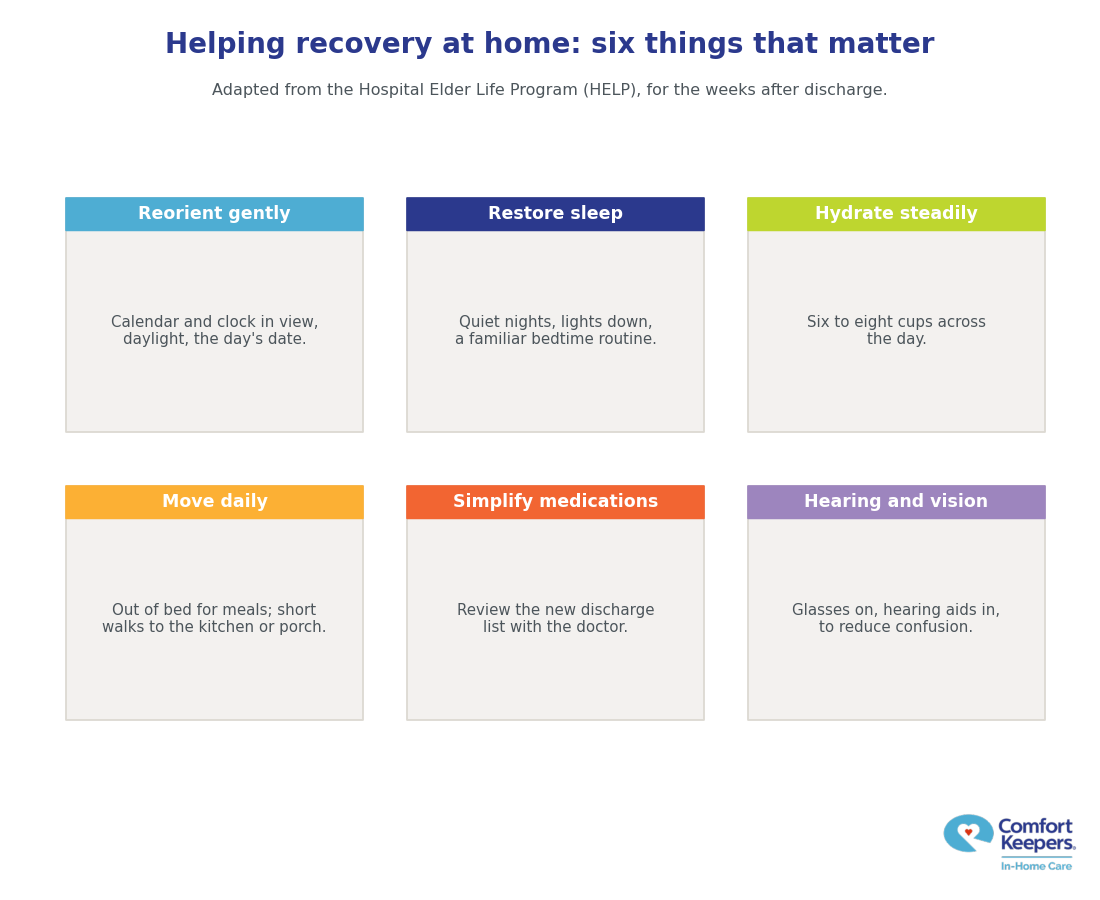
The Hospital Elder Life Program (HELP), developed at Yale, is a clinical protocol that reduces in-hospital delirium. Many of its components translate directly to home recovery. Our trained Director of Nursing, Lynn Guice, RN, and our caregivers work with families on these themes:
Reorient gently. Calendar visible. Clock visible. A window for natural light. The day's date mentioned in conversation in the morning. Family photographs in the bedroom. Brief, calm explanations of what is happening today.
Restore sleep. Quiet evening hours. Lights down. A familiar bedtime routine. No medical tasks at night that can be done in the day. The bedroom for sleeping, the living room for the rest.
Hydrate steadily. Six to eight cups of water across the day. Watered-down juice, soup, gelatin, and watermelon all count. Caffeine in the morning only.
Move daily. Out of bed for meals. A short walk to the kitchen, to the mailbox, to the porch. Sitting up rather than lying flat through the afternoon. Movement restores cognition faster than rest in most older adults recovering from delirium.
Reduce medication load. The discharge medication list is often longer than the pre-admission list. Some additions are temporary. Reviewing the list with the primary care doctor in the first week home surfaces the items that can be tapered.
Treat hearing and vision. Glasses on. Hearing aids in. The cognitive load of trying to interpret a half-heard or half-seen world is itself a delirium trigger.
A typical Pitman-area recovery timeline
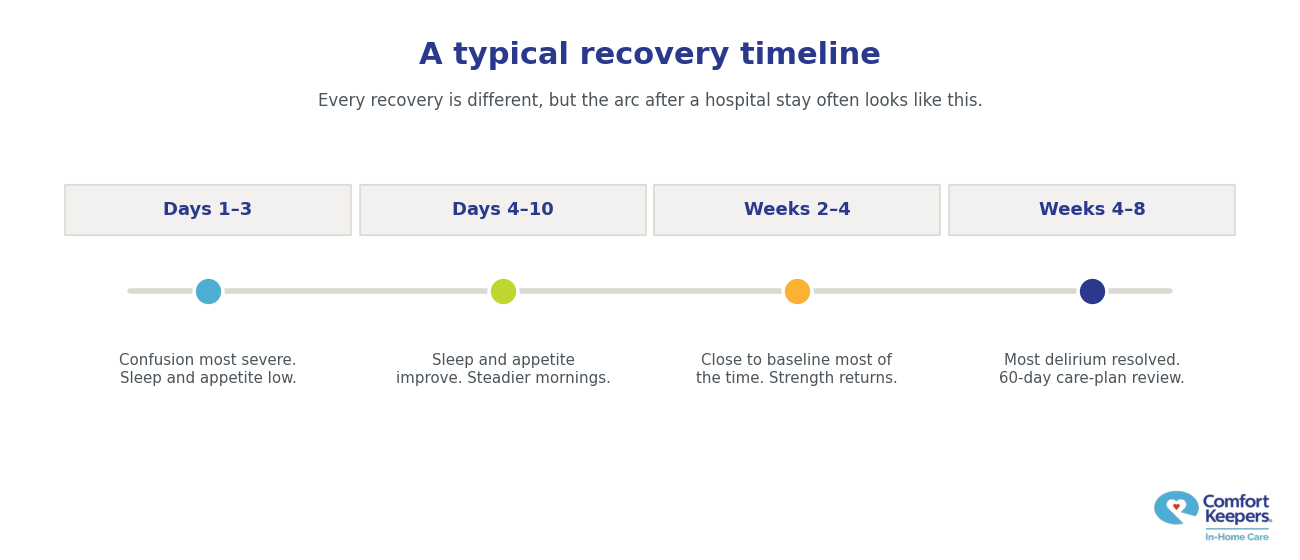
The trajectory varies a lot, but a common Pitman post-discharge picture looks something like this:
Days 1 to 3 home. Confusion most severe. Sleep disrupted. Appetite low. The senior may not recognize visitors easily or may want to stay in bed.
Days 4 to 10. Sleep improves. Appetite returns. Disorientation persists in the late afternoon and evening. The senior is steadier in the morning.
Weeks 2 to 4. Cognition is closer to baseline most of the time. Brief late-day confusion may continue. Physical strength returns slowly. The first physical therapy or follow-up appointment usually happens in this window.
Weeks 4 to 8. Most cases of delirium have fully resolved by this window. The 60-day Plan of Care review is when our team and the family decide on the next step.
Not every recovery is quick. In another case, a woman came home from the hospital and the delirium had not cleared. Her family was worried for the same reason, because she had been fine before she went in. We arranged for a caregiver to stay with her a few days a week on an ongoing basis, making sure she eats well, stays hydrated, and is looked after. The steady company and socialization have made a real difference, and her confusion has eased significantly.
What our caregivers and care team do
Care after a hospital discharge often starts with a few weeks of part-time or live-in support. The care team works together:
Our caregivers are in the home for the daily routines: bathing safely, getting to and from the bathroom, breakfast and lunch, light housework, and getting your loved one to outpatient appointments. Your Client Care Coordinator handles the schedule and the day-to-day, and is the person you call when an appointment shifts. Lynn Guice, RN, our trained Director of Nursing, runs the in-home Assessment and writes the Plan of Care, which is reviewed at 30 and 60 days as the senior recovers.
Most families step down from heavier care to lighter care as the recovery progresses. That is the right outcome. Some discontinue care after the 60-day review. Some keep a lighter weekly arrangement long-term. The 60-day Plan review is when we recommend the next step.
Frequently Asked Questions
My father came home from the hospital confused. Is this permanent?
Most cases of hospital delirium resolve over days to weeks when the underlying triggers are addressed and the home environment supports recovery. The fact that he was alert and oriented before the admission is the strongest predictor of full recovery.
How soon should we start home care after the discharge?
The first three days home are when families most often realize they need help. If the discharge planner flagged any concern, starting before the discharge is even better. We can sometimes start within a few days of the first call when the case is urgent and a trained caregiver is available.
Does Medicare cover this?
Medicare does not pay for non-medical home care. Long-term care insurance often does, and we bill the carrier directly when the policy allows. VA Aid and Attendance benefits help eligible veterans and surviving spouses. Medicaid waiver programs do not apply to our services.
How does this differ from a skilled nursing facility?
A skilled nursing facility provides 24/7 nursing care; home care does not. For many older adults recovering from a hospital stay without ongoing skilled nursing needs, home with professional caregiver support is the better environment for delirium recovery, because familiar routines and faces accelerate the cognitive recovery. The decision should involve the discharge team and the family, and we are happy to be part of that conversation.
What if my parent has dementia and developed delirium in the hospital?
This is common. The delirium often resolves on its own timeline while the dementia returns to whatever baseline it was at before. Our caregivers are trained in our Alzheimer's Association-recognized Positive Pathways™ approach for families dealing with the combination.
Is your office NIHCA-accredited?
Yes. The Pitman office is NIHCA-accredited.
When the days at home are not what you expected
If your loved one is coming home to Pitman, Sewell, Washington Township, Mullica Hill, Woodbury, or anywhere in Gloucester County after a hospital stay and the days at home are not what you expected, call Comfort Keepers of Pitman at (856) 582-1054. The consultation is no-cost. We will listen, walk through what is happening, and help you decide on the right level of support. Our work is to elevate the human spirit, one home and one family at a time.







